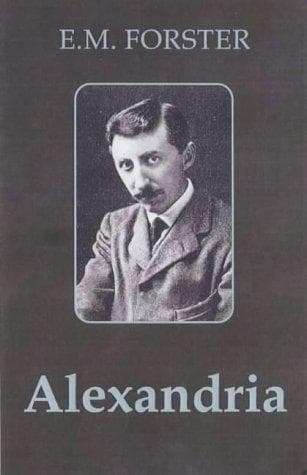
Alexandria: A History and a GuideForster, E. M. (Edward Morgan)
History
Alexandria: A History and a Guide
Forster, E. M. (Edward Morgan)
Alexandria (Egypt) -- Guidebooks; Alexandria (Egypt) -- History
The second storey was octagonal and entirely filled by the spiral
ascent. Above that was the circular third story, and above that the
lantern. The lighting arrangements are uncertain. Visitors speak of
a mysterious “mirror” on the summit, which was even more wonderful
than the building itself. What was this “mirror”? Was it a polished
steel reflector for the fire at night or for heliography by day?
Some accounts describe it as made of finely wrought glass or
transparent stone, and declare that a man sitting under it could see
ships at sea that were invisible to the naked eye. A telescope? Is
it possible that the great Alexandrian school of mathematics
discovered the lens, and that their discovery was lost and forgotten
when the Pharos fell? It is possible. It is certain that the
lighthouse was fitted with every scientific improvement known to the
age, that the antique world never surpassed it, and that the
mediaeval world regarded it as the work of Jinns.
Standing on the lantern was a statue of Poseidon. This terminated
the tower, whose complete height certainly exceeded 400 feet and
possibly touched 500.
(2) HISTORY OF THE BUILDING.
We must now follow this masterpiece of engineering into ages of myth
and oblivion. It retained its form and functions unimpaired up to
the Arab Conquest (A.D. 641). The first, and irreparable, disaster
was the fall of the lantern (about 700), entailing the loss of
scientific apparatus that could not be replaced. There is a legend
that the disaster was planned by the Byzantine Emperor, who could
not attack Egypt owing to the magic “Mirror,” which detected or
destroyed his ships. He sent an agent who gained the Caliph’s
confidence and told him that beneath the Pharos the treasure of
Alexander the Great lay buried. The Caliph commenced demolition, and
before the inhabitants of Alexandria, who knew better, could
intervene, the two upper stories had fallen into the sea. Henceforth
the Pharos is only a stump with a bonfire on the top.
There were restorations under Ibn Touloun (880), and also about 980,
but they were unsubstantial additions to the Octagon which the wind
could blow away. Structural repairs were neglected, and about 1100
the second disaster occurred—the fall of the Octagon itself through
an earthquake. The square bottom story survived, but only as a
watchtower on the top of which was run up a small square Mosque.
(_see_ Plan I, Fig. ii, which illustrates this state of the Pharos.
The level of the ground has risen owing to the debris from the
octagon, and the lower story has been buttressed). Then came the
final earthquake (14th cent.) and the slow dissolution was over.
Public-domain text, read in full here on John Shaqi.
Reviews
Reviews
No reviews yet
Be the first to share your thoughts on this work.
Elsewhere in the archive
Join the Discussion
Join the discussion
Sign in to leave a comment or review.
Sign InorCreate an account