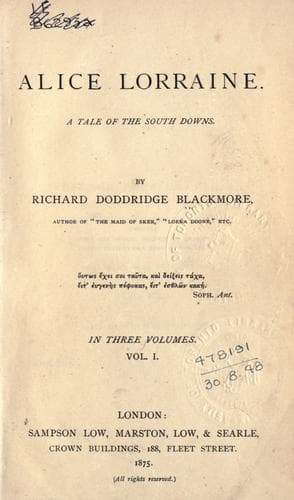
Alice Lorraine: A Tale of the South DownsBlackmore, R. D. (Richard Doddridge)
General
Alice Lorraine: A Tale of the South Downs
Blackmore, R. D. (Richard Doddridge)
Peninsular War, 1807-1814 -- Fiction; South Downs (England) -- Fiction
Meanwhile, Alice thought sadly over the many uncomfortable legends
concerning her ancient and dwindled race. The first outbreak of the
“Woeburn,” in the time of Edward the Third, A.D. 1349, was said to
have brought forth deadly poison from the hill-side whence it sprang.
It ran for seven months, according to the story to be found in one of
their earliest records, confirmed by an inscription in the church;
and the Earl of Lorraine and his seven children died of the “black
death” within that time. Only a posthumous son was left, to carry on
the lineage. The fatal water then subsided for a hundred and eleven
years; when it broke forth suddenly in greater volume, and ran for
three months only. But in that short time the fortune of the family
fell from its loftiest to its lowest; and never thenceforth was it
restored to the ancient eminence and wealth. On Towton field, in as
bloody a battle as ever was fought in England, the Lorraines, though
accustomed to driving snow, perished like a snow-drift. The bill of
attainder, passed with hot speed by a slavish Parliament, took away
family rank and lands, and left the last of them an outcast, with the
block prepared for him.
Nanny having set that coney boiling, and carefully latched the door,
hobbled at her best pace back to Alice, and resumed her subject.
“Holy water! Oh, ho, ho! Holy to old Nick, I reckon; and that be why
her boileth over so. Three wells there be in a row, you know, Miss, all
from that same spring I count; the well in Parson’s garden, and this,
and the uppest one, under the foot of your hill, above where that gipsy
boy harboureth. That be where the Woeburn breaketh ground.”
“You mean where the moss, and the cotton-grass is. But you can scarcely
call it a well there now.”
“It dothn’t run much, very like; and I ha’n’t been up that way for
a year or more. But only you try to walk over it, child; and you’d
walk into your grave, I hold. The time is nigh up for it to come out,
according to what they tells of it.”
“Very well, Nanny, let it come out. What a treat it would be this hot
summer! The Adur is almost dry, and the shepherd-pits everywhere are
empty.”
“Then you pay no heed, child, what is to come of it, if it ever comes
out again. Worse than ever comed afore to such a lot as you be.”
“I cannot well see how it could be worse than death, and dearth, and
slaughter, Nanny.”
“Now, that shows how young girls will talk, without any thought of
anything. To us poor folk it be wise and right to put life afore
anything, according to natur’; and arter that, the things as must go
inside of us. There let me think, let me think a bit. I forgets things
now; but I know there be some’at as you great folks count more than
life, and victuals, and natur’, and everythin’. But I forgets the word
you uses for it.”
“Honour, Nanny, I suppose you mean--the honour, of course, of the
family.”
Public-domain text, read in full here on John Shaqi.
Reviews
Reviews
No reviews yet
Be the first to share your thoughts on this work.
Elsewhere in the archive
Join the Discussion
Join the discussion
Sign in to leave a comment or review.
Sign InorCreate an account