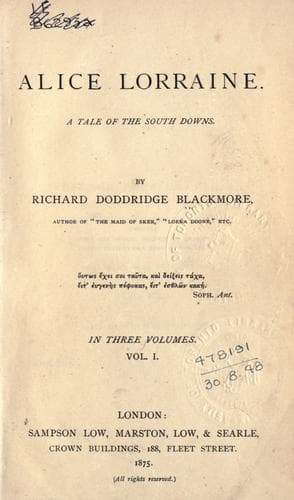
Alice Lorraine: A Tale of the South DownsBlackmore, R. D. (Richard Doddridge)
General
Alice Lorraine: A Tale of the South Downs
Blackmore, R. D. (Richard Doddridge)
Peninsular War, 1807-1814 -- Fiction; South Downs (England) -- Fiction
Here were heaps of trouble rising; as peaks of volcanoes come out of
the sea. And who was to know how to manage things, so as to make them
all subside again? Hilary might seem easy to deal with, so long as he
had no money; but even he was apt to take strange whims into his head,
although he might feel that he could not pay for them. And then there
was the Grower, an obstinate factor in any calculation; and then the
Grower’s wife, who might appeal perhaps to the Attorney-General; also
Sir Roland, with his dry unaccountable manner of regarding things; and
last, not least, the Rector’s own superior part of his household. If
he could not manage them, anybody at first sight would say that the
fault must be altogether his own--that a man who cannot lay down the
law to his own wife and daughters, really is no man, and deserves to be
treated accordingly. Yet this depends upon special gifts. The Rector
could carry on very well, when he understood the subject, even with his
wife and daughters, till it came to crying. Still in the end (as he
knew in his heart), he always got the worst of it.
Now what would all these ladies say, if the incumbent of the parish,
the rector of the rectory, the very husband or father of all of
themselves--as the case might be--were to depart from his sense of
right, and the principles he had laid down to them, to such an extent
as to cherish Hilary in black rebellion against his own father? Suasion
would be lost among them. It is a thing that may be tried, under
favourable circumstances, as against one lady, when quite alone; but
with four ladies all taking different views of the matter in question,
yet ready in a moment to combine against any form of reason,--a
bachelor must be Quixotic, a husband and father idiotic, if he relies
upon any other motive power than that of his legs. But the Rector was
not the man to run away, even from his own family. So, on the whole,
he resolved to let things follow their own course, until something new
should begin to rise. Except at least upon two little points--one, that
Hilary should be kept from visiting the farm just now; and the other,
that the Grower must be told of all this love-affair.
Mr. Hales, as an owner of daughters, felt that it was but a father’s
due, to know what his favourite child was about in such important
matters; and he thought it the surest way to set him bitterly against
any moderation, if he were left to find out by surprise what was going
on at his own hearth. It happened, however, that the Grower had a
shrewd suspicion of the whole of it, and was laughing in his sleeve,
and winking (in his own determined way) at his good wife’s manœuvres.
“I shall stop it all, when I please,” he said to himself, every night
at bed-time; “let them have their little game, and make up their minds
to astonish me.” For he, like almost every man who has attained the age
of sixty, looked back upon love as a brief excrescence, of about as
much importance as a wart.
Public-domain text, read in full here on John Shaqi.
Reviews
Reviews
No reviews yet
Be the first to share your thoughts on this work.
Elsewhere in the archive
Join the Discussion
Join the discussion
Sign in to leave a comment or review.
Sign InorCreate an account