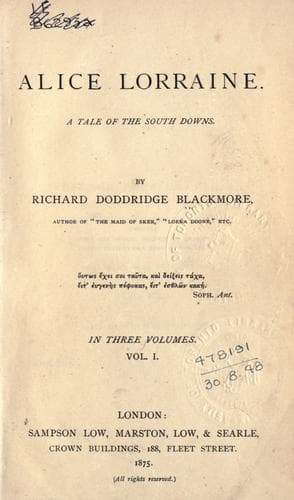
Alice Lorraine: A Tale of the South DownsBlackmore, R. D. (Richard Doddridge)
General
Alice Lorraine: A Tale of the South Downs
Blackmore, R. D. (Richard Doddridge)
Peninsular War, 1807-1814 -- Fiction; South Downs (England) -- Fiction
Alice had “plenty of spirit of her own,” which of course she called
“sense of dignity;” but in spite of it all, she was most unwilling to
encounter her valiant grandmother. And she knew that this encounter was
announced the moment she was sent for.
“Is my hair right? Are my bows right? Has the old dog left any
paw-marks on me?” she asked herself; but would rather have died--as
in her quick way she said to herself--than have confessed her fright
by asking any of the maids to tell her. Betwixt herself and her
grandmother there was little love lost, and still less kept; for
each looked down upon the other from the heights of impartial duty.
“A flighty, romantic, unfledged girl, with no deference towards her
superiors”--“A cold-blooded, crafty, plotting old woman, without a bit
of faith in any one;”--thus each would have seen the other’s image, if
she had looked into her own mind, and faced its impressions honestly.
The elder lady, having cares of her own, contrived for the most part to
do very well without seeing much of her grandchild; who on the other
hand was quite resigned to the affliction of this absence. But Alice
could never perceive the justice of the reproaches wherewith she was
met, whenever she came, for not having come more often where she was
not wanted.
Now with all her courage ready, and not a sign in eye, face, or
bearing, of the disquietude all the while fluttering in the shadow of
her heart, the young lady looked at the ancient lady respectfully,
and saluted her. Two fairer types of youth and age, of innocence and
experience, of maiden grace and matron dignity, scarcely need be sought
for; and the resemblance of their features heightened the contrast of
age and character. A sculptor might have been pleased to reckon the
points of beauty inherited by the maiden from the matron--the slim
round neck, the graceful carriage of the well-shaped head, the elliptic
arch of brow, the broad yet softly-moulded forehead, as well as the
straight nose and delicate chin--a strong resemblance of details, but
in the expression of the whole an even stronger difference. For Alice,
besides the bright play of youth and all its glistening carelessness,
was gifted with a kinder and larger nature than her grandmother. And as
a kind, large-fruited tree, to all who understand it, shows--even by
its bark and foliage and the expression of its growth--the vigour of
the virtue in it, and liberality of its juice; so a fine sweet human
nature breathes and shines in the outer aspect, brightens the glance,
and enriches the smile, and makes the whole creature charming.
But Alice, though blest with this very nice manner of contemplating
humanity, was quite unable to bring it to bear upon the countenance of
her grandmother. We all know how the very best benevolence perpetually
is pulled up short; and even the turn of a word, or a look, or a breath
of air with a chill in it scatters fine ideas into corners out of
harmony.
Public-domain text, read in full here on John Shaqi.
Reviews
Reviews
No reviews yet
Be the first to share your thoughts on this work.
Elsewhere in the archive
Join the Discussion
Join the discussion
Sign in to leave a comment or review.
Sign InorCreate an account