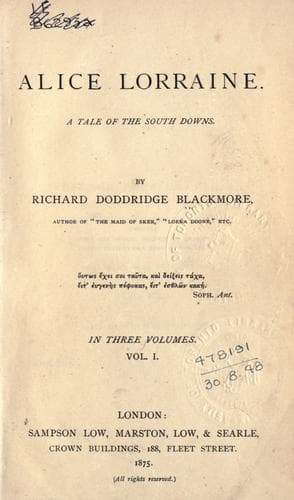
Alice Lorraine: A Tale of the South DownsBlackmore, R. D. (Richard Doddridge)
General
Alice Lorraine: A Tale of the South Downs
Blackmore, R. D. (Richard Doddridge)
Peninsular War, 1807-1814 -- Fiction; South Downs (England) -- Fiction
There would seem to be times, and scenes, and cases, in which human
nature falls helpless under sudden contamination, a mental outbreak of
black murrain, leprosy, or plague. A panic, a superstitious fervour, a
patriotic or social rush, a rebellion, a “revival”--all of these drive
men in masses, like swine down a precipice; but the sack of a large
town bloodily stormed is more maddening than all the rest put together.
Even good and steady soldiers caught the taint of villainy. They
confessed (when their headaches began to get better) how thoroughly
ashamed they were of themselves, for having been led into crime and
debauch by the scamps and the scum of the regiment. Still, at the
moment, they were as bad as, or even worse than consistent blackguards;
because they had more strength to rush astray.
Hilary knew mankind very little, and only from a gentleman’s point of
view; so that when he found, or lost, his way into the great square of
the town, he was quite amazed, in his weak state of mind, by the scene
he was breaking into. Here, by the light of a blazing bonfire, made
of costly furniture, he descried Major Clumps, of his regiment, more
neatly than pleasantly attached to the front door of a large mansion.
Across his breast and arms a couple of musket-straps were tightly
strained and pegged with bayonets into the timber so firmly that this
active officer could not even put foot to the ground. On his head was
a very conspicuous fool’s cap made of a copy of a proclamation, with
that word in large type above his brows; while a gigantic grenadier,
as tipsy as a fiddler, was zealously conducting the exhibition, by
swinging him slowly to and fro, to the tune of Margery Daw, even as
children swing each other on a farm-yard gate. The Major’s fury and the
violence of his language may be imagined, but must not be reported.
He had always been famous for powers of swearing; but in this case he
outdid himself, renewing (every moment) and redoubling the grins of all
spectators.
“You shall swing for this,” he screamed to his showman, just as Hilary
came up; “you shall swing for this, you,” etc., etc.
“You shwing first, old cock, at any rate,” the grenadier answered, with
a graceful sweep of the door and the pendent major.
“Oh Lorraine, Lorraine,” cried the latter, as the arc of his revolution
brought him face to face with Hilary; “for heaven’s sake, stop these
miscreants--ah, you can do nothing, I see--you are hit badly, my poor
boy.”
“My friend,” said Hilary to the grenadier, with that persuasive grace
which even the costermongers could not resist; “you are much too good
a soldier to make a laughing-stock of a brave British officer. I
cannot attempt to use force with you, for you are lucky enough to be
unwounded. Thank God for that, and release your prisoner--remember he
is not a Frenchman, but a brave and good English major.”
Public-domain text, read in full here on John Shaqi.
Reviews
Reviews
No reviews yet
Be the first to share your thoughts on this work.
Elsewhere in the archive
Join the Discussion
Join the discussion
Sign in to leave a comment or review.
Sign InorCreate an account