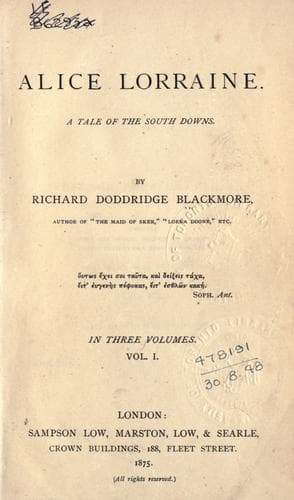
Alice Lorraine: A Tale of the South DownsBlackmore, R. D. (Richard Doddridge)
General
Alice Lorraine: A Tale of the South Downs
Blackmore, R. D. (Richard Doddridge)
Peninsular War, 1807-1814 -- Fiction; South Downs (England) -- Fiction
The loss of his laurels was all the more bitter to the brave and
choleric Major, not only because it was always happening--which
multiplied it into itself at every single recurrence--but also because
he had been rapidly, even for his time of life, subdued by the tender
and timorous glances of the sweet young Donna Camilla. The greater the
fright this girl was in, the better it suited her appearance; and when
she expected to be immolated (as the least of impending horrors), her
face was as that of an angel. The Major, although trussed tight with
whipcord, and full of an old stocking in his mouth, had enjoyed the
privilege of gazing at her while she clasped her crucifix. And that
picture would abide upon his retentive, stubborn, and honest brain as
long as the brain itself abode. He loved an Angelical girl, because his
late wife had been slightly Demoniac.
Now, by the time that our British soldiers had finished their sack of
Badajos--which took them three days, though they did their best--and
were beginning to be all laid up (in spite of their iron trim and
training) by their own excesses, Lorraine was able to turn in his
bed, and to pay a tender heed to things. He began to want some sort
of change from the never-wearying, but sometimes wearisome, tendence
of old Teresina, whose rugged face and pointed cap would dwell in his
dreams for ever. Of course he was most grateful to her, and never
would forget her kindness. Still he longed for a sight of somebody
else; ugly or beautiful he cared not--only let it be some other face.
And his wish was granted, as generally happened, and sometimes only too
graciously.
Our very noble public schools and ancient universities know, and always
have known, how to educate young people. From long experience, they
are well aware that all languages are full of mischief; and a man who
desires that element finds it almost wherever he pleases. So that our
authorities did well to restrict themselves to the grand old form, and
the distance of two thousand years. Hence, as a matter of course, poor
Hilary had not learned, either at school or college, even one irregular
verb of the fine pervasive and persuasive language of all languages. To
put it more simply, he could not speak French. In print he could follow
it, off and on (as most men, with Latin to lead them, can); but from
live lips it was gibberish to him, as even at this day it is to nine
and a half out of ten good Britons.
And now, when suddenly a soft rich voice came over his shoulder (just
turned once more in great disgust from the dreary door) and asked,
in very good French indeed, “How do you carry yourself, sir?” Hilary
was at a pinch to answer, “Most well, a thousand thanks, most well.”
And after this Anglo-Gallic triumph, he rolled on his bandages very
politely (in spite of all orders to the contrary) to see who it was,
and to look at her.
Public-domain text, read in full here on John Shaqi.
Reviews
Reviews
No reviews yet
Be the first to share your thoughts on this work.
Elsewhere in the archive
Join the Discussion
Join the discussion
Sign in to leave a comment or review.
Sign InorCreate an account