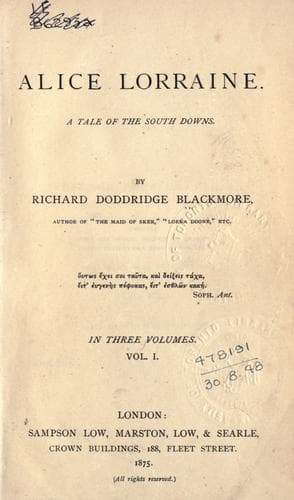
Alice Lorraine: A Tale of the South DownsBlackmore, R. D. (Richard Doddridge)
General
Alice Lorraine: A Tale of the South Downs
Blackmore, R. D. (Richard Doddridge)
Peninsular War, 1807-1814 -- Fiction; South Downs (England) -- Fiction
The daffodil that comes and “takes the winds of March with beauty,”
here reserves that charming capture for the early breeze of May; for
still the “black-thorn winter” buffets the folds of chilly April’s
cloak, and the hail-fringed mantle of wan sunlight. This is the time
when a man may say, “Hurrah! Here is summer come at last, I verily do
believe. For goodness’ sake, wife, give us air, and take those hot
things from the children’s necks. If you want me, I shall be in the
bower, having a jolly pipe at last.” And then by the time all the
windows are open, and the little ones are proud to show their necks and
the scratches of their pins, in rushes papa, with his coat buttoned
over, and his pipe put out by hail.
None the less for all that, the people who like to see things
moving--though it be but slowly--have opportunity now of watching small
delights that do them good. How trees, and shrubs, and plants, and even
earth and stone, begin to feel the difference coming over them. How
little points, all black one day, and as hard as the tip of a rook’s
bill the next time of looking at them, show a little veiny shining.
And then as the people come home from church, and are in their most
observant humour, after long confinement, a little child finds a real
leaf (most likely of an elder-tree), and many young faces crowd around
it; while the old men, having seen too many springs, plod on and doubt
this for a bad one.
Much of this had been done, with slow advance from Sunday to Sunday,
and the hedges began to be feathered with green, and the meadows to
tuft where the good stuff lay, and the corn in the gloss of the sun to
glisten; when everybody came out of church one Sunday before Pentecost.
The church was that which belonged to the Rev. Struan Hales (in his
own opinion), and so did the congregation, and so did everything,
except the sermon. And now the Rector remained in the vestry, with his
favourite daughter Cecil, to help him off with his “academicals,” and
to put away his comb.
“I hope your mother will be quick, my dear,” said the Parson, stooping
his broad shoulders, as his daughter tugged at him; “she cannot walk as
she used, you know; and for the last half-hour I have been shuddering
and trembling about our first fore-quarter.”
“I saw that you were uncomfortable, papa, just as you were giving out
your text. You seemed to smell something burning, didn’t you?”
“Exactly!” said the Rector, gazing with surprise at his clever and
queer Cecil. “Now how could you tell? I am sure I hope none of the
congregation were up to it. But 9_d._ a pound is no joke for the father
of three hungry daughters.”
“And with a good appetite of his own, papa. Well, I’ll tell you how I
knew it. You have a peculiar way of lifting your nose when the meat
is too near the fire, as it always is with our new cook; and then you
looked out of that round-arched window, as if you expected to see some
smoke.”
Public-domain text, read in full here on John Shaqi.
Reviews
Reviews
No reviews yet
Be the first to share your thoughts on this work.
Elsewhere in the archive
Join the Discussion
Join the discussion
Sign in to leave a comment or review.
Sign InorCreate an account