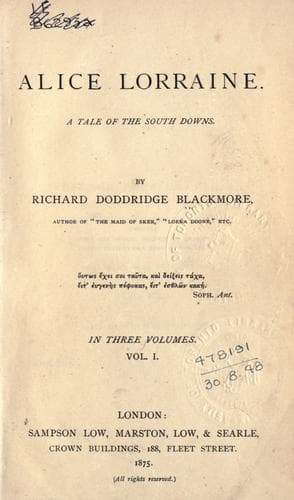
Alice Lorraine: A Tale of the South DownsBlackmore, R. D. (Richard Doddridge)
General
Alice Lorraine: A Tale of the South Downs
Blackmore, R. D. (Richard Doddridge)
Peninsular War, 1807-1814 -- Fiction; South Downs (England) -- Fiction
“And I have got him,” said Mabel, smiling; “and I won’t let him go.
And I won’t believe a single word against him, until he tells me that
it is true himself. Do you think that he would not have written to me,
even with the stump of his left hand, and said, ‘Mabel, I am tired of
you; Mabel, I have seen prettier girls, and more of my own rank in
life; Mabel, you must try to forget me’? When he does that, I shall cry
in real earnest; and there will be no more Mabel.”
“Come in to supper, my pet,” said Gregory. And she came in to supper,
with her sweet eyes shining.
CHAPTER XLV.
INNOCENCE IN NO SENSE.
Near the head of a pass of the Sierra Morena, but out of the dusty
track of war, there stood a noble mansion, steadfast from and to
unknown ages. The Moorish origin, here and there, was boldly manifest
among Spanish, French, and Italian handiwork, both of repair and
enlargement. The building must have looked queer at times, with new
and incongruous elements; but the summer sun and the storms of winter
had enforced among them harmony. So that now this ancient castle of
the Counts of Zamora was a grand and stately pile in tone, as well as
height and amplitude.
The position also had been chosen well; for it stood near the line
of the watershed, commanding northward the beautiful valley of the
Guadiana, and southward the plains of the Guadalquivir; so that, as the
morning mists rolled off, the towers of Merida might be seen, and the
high ground above Badajos; while far on the opposite skyline flashed
the gilt crosses of Cordova; and sometimes, when the distance lifted, a
glimpse was afforded of the sunbeams quivering over Seville. And here,
towards the latter end of August, 1812, Hilary Lorraine was a guest,
and all his wishes law--save one.
The summer had been unusually hot, even for the south of Spain; and
a fifth part of the British army was said to be in hospital. This
may have been caused in some degree by their habits of drinking
and plundering; which even Lord Wellington declared himself unfit
to cope with. To every division of his army he appointed twenty
provost-marshals; whereas two hundred would not have been enough to
hang these heroes punctually. The patriotic Spaniards also could not
see why they should not have some comfort from their native land.
Therefore they overran it well, with bands of fine fellows of a warlike
cast, and having strong tendencies towards good things; and these
were of much use to the British, not only by stopping the Frenchmen’s
letters, but also by living at large and gratis, so that the British,
who sometimes paid, became white sheep by the side of them.
One of the fiercest of these Guerillas--or “Partidas,” as they called
themselves--was the notorious Mina; and for lieutenant he had a man of
lofty birth, and once good position, a certain Don Alcides d’Alcar, a
nephew of the Count of Zamora.
Public-domain text, read in full here on John Shaqi.
Reviews
Reviews
No reviews yet
Be the first to share your thoughts on this work.
Elsewhere in the archive
Join the Discussion
Join the discussion
Sign in to leave a comment or review.
Sign InorCreate an account