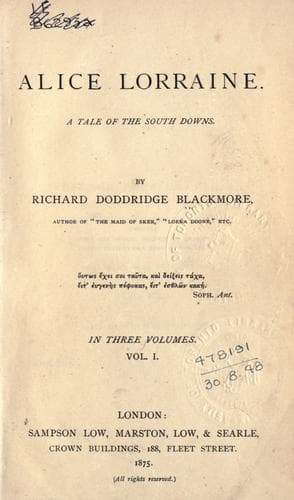
Alice Lorraine: A Tale of the South DownsBlackmore, R. D. (Richard Doddridge)
General
Alice Lorraine: A Tale of the South Downs
Blackmore, R. D. (Richard Doddridge)
Peninsular War, 1807-1814 -- Fiction; South Downs (England) -- Fiction
But now in the breath of the evening breeze, setting inland from the
Atlantic, Lorraine was roving for the last time in the grounds of
Monte Argento. At three in the morning he must set forth, with horses
provided by his host, on his journey to head-quarters. The Count was
known as a patriotic, wise, and wealthy noble, both of whose sons
were fighting bravely in the Spanish army; and through his influence
Lorraine had been left to hospitality instead of hospitals, which in
truth had long been overworked. But Major Clumps had returned to his
duty long ago, with a very sore heart, when he found from the Donna
Camilla that “she liked him very much indeed, but could never induce
herself to love him.” With the sharp eye of jealousy, that brave Major
spied in Hilary the cause of this, and could not be brought to set down
his name any more in his letters homeward; or at any rate, not for a
very long time.
Lorraine, in the calm of this summer evening, with the heat-clouds
moving eastward, and the ripple of refreshment softly wooing the
burdened air, came to a little bower, or rather a natural cove of
rock and leaf, wherein (as he knew) the two fair sisters loved to
watch the eventide weaving hill and glen with shadow, before the
rapid twilight waned. There was something here that often brought his
native Southdowns to his mind, though the foliage was so different.
Instead of the rich deep gloss of the beech, the silvery stir of the
aspen-tree, and the feathery droop of the graceful birch, here was the
round monotony of the olive and the lemon-tree, the sombre depth of
the ilex, and the rugged lines of the cork-tree, relieved, it is true,
just here and there by the symmetry of the silver fir, and the elegant
fan of the palm. But what struck Lorraine, and always irked him under
these southern trees and skies, was the way in which the foliage cut
its outline over sharply; there was none of that hovering softness, and
sweetly fluctuating margin, by which a tree inspires affection as well
as admiration.
Unluckily now Lorraine had neither affection nor admiration left for
the innocent beauty of nature’s works. His passion for Claudia was
become an overwhelming and noxious power--a power that crushed for
the time and scattered all his better elements. He had ceased to be
light-hearted, and to make the best of everything, to love the smiles
of children, and to catch a little joke and return it. He had even
ceased to talk to himself, as if his conscience had let him know that
he was not fit to be talked to. All the waking hours he passed, in the
absence of his charmer, were devoted to the study of Spanish; and he
began to despise his own English tongue. “There is no melody in it, no
rhythm, no grand sonorous majesty,” he used to complain; “it is like
its owners, harsh, uncouth, and countrified.” After this, what can any
one do but pity him for his state of mind?
Public-domain text, read in full here on John Shaqi.
Reviews
Reviews
No reviews yet
Be the first to share your thoughts on this work.
Elsewhere in the archive
Join the Discussion
Join the discussion
Sign in to leave a comment or review.
Sign InorCreate an account