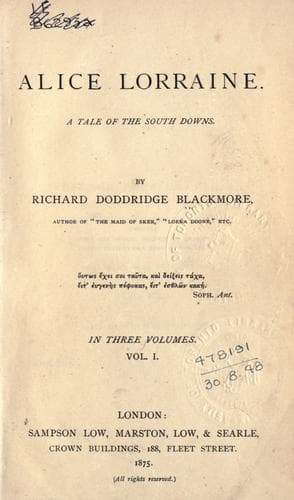
Alice Lorraine: A Tale of the South DownsBlackmore, R. D. (Richard Doddridge)
General
Alice Lorraine: A Tale of the South Downs
Blackmore, R. D. (Richard Doddridge)
Peninsular War, 1807-1814 -- Fiction; South Downs (England) -- Fiction
In those old times of heavy pounding, scanty food, and great hardihood,
when war was not accounted yet as one of the exact sciences, and
soldiers slept, in all sorts of weather, without so much as a blanket
round them, much less a snug tent overhead, the duties of the different
branches of the service were not quite so distinct as they are now.
Lieutenant Lorraine--for the ladies had given over-rapid promotion
when they called him their “brave captain”--had not rejoined his
regiment long before he obtained acknowledgment of his good and gallant
actions. Having proved that he could sit a horse, see distinctly at
long distance, and speak the Spanish language fairly--thanks to the two
young Donnas--and possessed some other accomplishments (which would now
be tested by paper work), he received an appointment upon the Staff,
not of the Light Division, but at Head-quarters, under the very keen
eyes of “the hero of a hundred fights.”
If the brief estimate of his compeers is of any importance to a man
of powerful genius--as no doubt it must be, by its effect on his
opportunities--then the Iron Duke, though crowned with good luck (as
everybody called each triumph of his skill and care), certainly seems
to have been unlucky as to the date of his birth and work. “Providence
in its infinite wisdom”--to use a phrase of the Wesleyans, who claim
the great general as of kin to their own courageous founder--produced
him at a time, no doubt, when he was uncommonly needful; but when (let
him push his fame as he would, by victory after victory) there always
was a more gigantic, because a more voracious, glory marching far in
front of him. Our great hero never had the chance of terrifying the
world by lopping it limb by limb and devouring it; and as noble glory
is the child of terror (begotten upon it by violence), the fame of
Wellington could never vie with Napoleon’s glory.
To him, however, this mattered little, except that it often impaired
his means of discharging his duty thoroughly. His present duty was to
clear the Peninsula of Frenchmen; and this he would perhaps have done
in a quarter of the time it cost, if his own country had only shown due
faith in his abilities. But the grandeur of his name grew slowly (as
the fame of Marcellus grew), like a tree in the hidden lapse of time;
and perhaps no other general ever won so many victories, before his
country began to dream that he could be victorious.
Public-domain text, read in full here on John Shaqi.
Reviews
Reviews
No reviews yet
Be the first to share your thoughts on this work.
Elsewhere in the archive
Join the Discussion
Join the discussion
Sign in to leave a comment or review.
Sign InorCreate an account