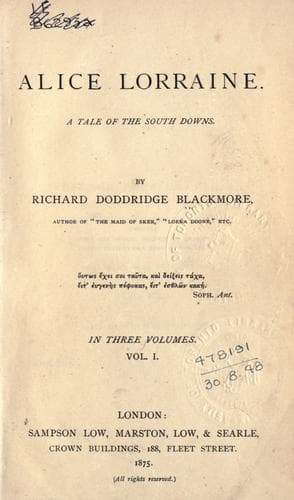
Alice Lorraine: A Tale of the South DownsBlackmore, R. D. (Richard Doddridge)
General
Alice Lorraine: A Tale of the South Downs
Blackmore, R. D. (Richard Doddridge)
Peninsular War, 1807-1814 -- Fiction; South Downs (England) -- Fiction
On the peaked crown of the old arch he stood, and looked both up and
down the river. Towards the mountains there was nothing but loneliness
and rugged shadow; scarred with clefts of moonlight, and at further
distance fringed with mist. And down the water, and the quiet sloping
of the lowlands, everything was feeding on the comfort of the summer
night; the broad delicious calm of lying under nature’s womanhood;
when the rage of the masculine sun is gone, and fair hesitation comes
after it.
Hilary looked at all these things; but did not truly see them. He
took a general idea that the view was beautiful; and he might have
been glad, at another time, to stand and think about it. For the
present, however, his time was short, and he must make the most of it.
The British detachment might appear at the ford, at any moment; and
his duty would be to haste thither at once, and see to the transfer
of convoy. And to make sure of this, he had begged that the Spanish
trumpets might be sounded; while he kept his own horse waiting for him,
and grazing kindly where the grass was cold.
The shadow of the old keep, and the ivy-mantled buttress, fell along
the roadway of the bridge, and lay in scollops there. Beyond it, every
stone was clear (of facing or of parapet), and the age of each could be
guessed almost, and its story, and its character. Even a beetle, or an
earwig, must have had his doings traced, if an enemy were after him.
But under the eaves of the lamp of night, and within all the marge of
the glittering, there lay such darkness as never lies in the world,
where the noon is less brilliant. Hilary stood in the broad light
waiting; and out of the shadow came Claudia.
“I doubted whether you would even do me the honour to meet me here,”
she said; “oh, Hilary, how you are changed to me!”
“I have changed in no way, senhorita; except that I know when I am
loved.”
“And you do not know--then you do not know--it does not become me to
say it, perhaps. Your ways are so different from ours, that you would
despise me if I told it all. I will not weep. No, I will not weep.”
With violent self-control, she raised her magnificent eyes to prove her
words; but the effort was too much for her. The great tears came, and
glistened in the brilliance of the moonlight; but she would not show
them, only turned away; and wished that nobody in the world should know
the power of her emotions.
“Come, come!” said Hilary (for an Englishman always says “come, come,”
when he is taken aback), “you cannot mean half of this, of course.
Come, Claudia; what can have made you take such a turn? You never used
to do it!”
“Ah, I may have been fickle in the days gone by. But absence--absence
is the power that proves----”
“Hark! I hear a sound down the river! Horses’ feet, and wheels, and
clashing----”
“No; it is only the dashing of the water. I know it well. That is why
this bridge is called the ‘bridge of echoes.’ The water makes all sorts
of sounds. Look here; and I will show you.”
Public-domain text, read in full here on John Shaqi.
Reviews
Reviews
No reviews yet
Be the first to share your thoughts on this work.
Elsewhere in the archive
Join the Discussion
Join the discussion
Sign in to leave a comment or review.
Sign InorCreate an account