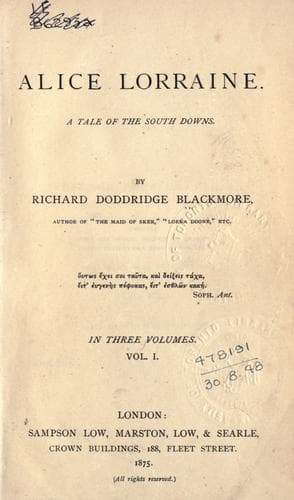
Alice Lorraine: A Tale of the South DownsBlackmore, R. D. (Richard Doddridge)
General
Alice Lorraine: A Tale of the South Downs
Blackmore, R. D. (Richard Doddridge)
Peninsular War, 1807-1814 -- Fiction; South Downs (England) -- Fiction
“You are a philosopher,” answered Lorraine; “it is pleasing to find
such a view of the case. But as for me, I am a ruined man. No captain,
nor even ‘your honour,’ any more.”
“Your honour must keep your spirits up. It mayn’t be so bad as your
honour thinks,” they answered very kindly, well knowing that he was a
ruined man, but saluting him all the more for it.
CHAPTER LI.
EMPTY LOCKERS.
It may perhaps be said, without any painful exaggeration, that
throughout the whole course of this grand war, struggle of great
captains, and heroic business everywhere, few things made a deeper,
sadder, and more sinister impression than the sudden disappearance
of those fifty thousand guineas. On the other hand, it must not be
supposed that the disappearance of guineas was rare. Far otherwise--as
many people still alive can testify; and some of them perhaps with
gratitude for their reappearance in the right quarter. But these
particular fifty thousand were looked out for in so many places, and
had so long been the subject of hope, as a really solid instalment of
a shilling in the pound for heroes, that the most philosophical of
these latter were inclined to use a short, strong word, of distinctive
nationality.
Poor Hilary felt that for this bad verb his own name must be the
receptive case; and he vainly looked about for any remedy or rescue.
Stiff as he was in the limbs, by reason of the straps of Don Alcides,
and giddy of head from the staff of that most patriotic Spaniard, he
found it for some time a little hard to reflect as calmly as he should
have done. Indeed it was as much as he could do to mount his horse--who
(unlike his master) had stuck to his post very steadfastly--and with
sadness alike with soul and body to ride down to the fatal ford.
Sergeant-major Bones and Corporal Nickles also remounted and followed
the bewildered captain, keeping behind him at a proper distance for
quiet interchange of opinion.
“Corporal, now,” said the sergeant-major, sliding his voice from
behind one hand, “what may be your sentiments as consarns this very
pecooliar and most misfortunate haxident?”
“Sergeant, it would be misbehooving,” replied Nickles, who was a
west-country man, “as well as an onceremonious thing for me to spake
first in the matter. To you it belongeth, being the one as foretold it
like a book; likewise senior hofficer.”
“Corporal, you are a credit to the army. Your discretion, at your
age, is wonderful. There be so few young men as remember when a man
has spoken right. I am the last man in the world to desire to be
overpraised, or to take to myself any sense of it. And now I wants no
credit for it. To me it seems to come natteral to discern things in a
sort of way that I find in nobody else a’most.”
Public-domain text, read in full here on John Shaqi.
Reviews
Reviews
No reviews yet
Be the first to share your thoughts on this work.
Elsewhere in the archive
Join the Discussion
Join the discussion
Sign in to leave a comment or review.
Sign InorCreate an account