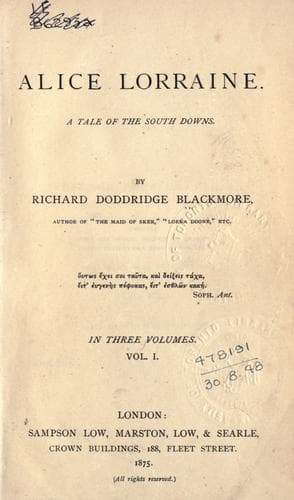
Alice Lorraine: A Tale of the South DownsBlackmore, R. D. (Richard Doddridge)
General
Alice Lorraine: A Tale of the South Downs
Blackmore, R. D. (Richard Doddridge)
Peninsular War, 1807-1814 -- Fiction; South Downs (England) -- Fiction
The hero of a hundred fights (otherwise called “Old Beaky”) had just
scraped through a choking trouble on the score of money with the
grasping Portuguese regency; and now, in the year 1813, he was busier
than even he had ever found himself before. He had to combine, in most
delicate manner, and with exquisite nicety of time, the movements of
columns whose number scarcely even to himself was clear; for the force
of rivers unusually strong, and the doubt of bridges successively
broken, and the hardship of the Tras os Montes, and the scattering of
soldiers, who for want of money had to “subsist themselves”--which
means to hunt far afield after cows, sheep, and hens--also the
shifty and unpronounced tactics of the enemy, and a great many other
disturbing elements, enough to make calculation sea-sick,--a senior
wrangler, or even Herr Steinitz (the Wellington of the chess-board),
each in his province, might go astray, and trust at last to luck itself
to cut the tangled knot for him.
It was a very grand movement, and triumphantly successful; opening up
as fine a march as can be found in history, sweeping onward in victory,
and closing with conquest of the Frenchmen in their own France, and
nothing left to stop the advance on Paris. “Was all this luck, or was
it skill?” the historian asks in wonder; and the answer, perhaps, may
be found in the proverb--“Luck has a mother’s love for skill.”
Be that as it may, it is quite certain that Hilary, though he had
shown no skill, had some little luck in the present case. For the
Commander-in-Chief was a great deal too busy, and had all his officers
too hard at work, to order, without fatal loss of time, a general
court-martial now. Moreover, he had his own reasons for keeping the
matter as quiet as possible, for at least another fortnight. Every
soldier by that time would be in march, and unable to turn his back on
Brown Bess: whereas now there were some who might lawfully cast away
the knapsack, if they knew that their bounty was again no better than
a cloudy hope. And, again, there were some ugly pot-hooks of English
questions to be dealt with.
All these things passed through the rapid mind of the General, as he
reined his horse, and listened calmly to poor Lorraine’s over-true
report. And then he fixed his keen grey eyes upon Hilary, and said
shortly--
“What were you doing upon that bridge?”
“That is a question,” replied Lorraine, while marvelling at his own
audacity, “which I am pledged by my honour, as a gentleman, not to
answer.”
“By your duty as an officer, in a place of special trust, you are bound
to answer it.”
“General, I cannot. My lord, as I rather must call you now, I wish I
could answer; but I cannot.”
“You have no suspicion who it was that stole the money, with so much
care?”
“I have a suspicion, but nothing more; and it makes me feel
treacherous, to suspect it.”
“Never mind that. We have rogues to deal with. What is your suspicion?”
Public-domain text, read in full here on John Shaqi.
Reviews
Reviews
No reviews yet
Be the first to share your thoughts on this work.
Elsewhere in the archive
Join the Discussion
Join the discussion
Sign in to leave a comment or review.
Sign InorCreate an account