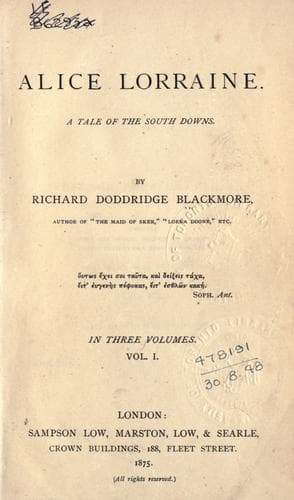
Alice Lorraine: A Tale of the South DownsBlackmore, R. D. (Richard Doddridge)
General
Alice Lorraine: A Tale of the South Downs
Blackmore, R. D. (Richard Doddridge)
Peninsular War, 1807-1814 -- Fiction; South Downs (England) -- Fiction
The dark and deep stream, which now had grown to a width of some twelve
yards perhaps, was gliding swiftly, but without a murmur, towards the
broad and watery moon. On the right-hand side, steep scars of chalk,
shedding gleams of white rays, made the hollow places darker; while on
the other side, furzy tummocks, patches of briar, and tufted fallows
spread the many-pointed light among their shadows justly.
“Please to listen,” again said Alice, shrinking from her father, lest
she might be felt to tremble. “What a plaintive, thrilling sound! It
must be a good banshee, I am sure; a banshee that knows how good we
are, and protests against our extinction. There it is again--and there
seems to be another wail inside of it.”
“A Chinese puzzle of noises, Lallie, and none of them very musical.
Your ears are keener than mine, of course; but being extinct of
romance, I should say that I heard a donkey braying.”
“Papa, now! papa, if it comes to that--and I said it was like Uncle
Struan’s voice! But I beg his pardon, quite down on my knees, if you
think that it can be a donkey.”
“I am saved all the trouble of thinking about it. There he is, looking
hard at us!”
“Oh no, papa, he is not looking hard at us. He is looking most softly
and sadly. What a darling donkey! and his nose is like a snowdrop!”
Clearly in the moonlight shone, on the opposite bank of the Woeburn,
the nose of Jack the donkey. His wailings had been coming long, and
his supplications rising; he was cut off from his home, and fodder,
and wholly beloved Bonny. And the wail inside a wail--as Alice had
described it--was the sound of the poor boy’s woe, responsive to the
forlorn appeal of Jack. On the brink of the cruel dividing water they
must have been for a long time striding up and down, over against each
other, stretching fond noses vainly forward, and outvying one another
in the luxury of poetic woe.
“Don’t say a word, papa,” whispered Alice; “the boy cannot see us here
behind this bush, and we can see him beautifully in the moonlight. I
want to know what he will do, so much.”
“I don’t see what he can do except howl,” Sir Roland answered quietly:
“and certainly he seems to possess remarkable powers in that way.”
“Bo-hoo, hoo, hoo, hoo!” wept Bonny in confirmation of this opinion;
and “eke-haw, eke-haw,” from a nose of copious pathos, formed the
elegiac refrain. Then having exhausted the well of weeping, the boy
became fitter for reasoning. He wiped his eyes with his scarlet
sleeves, and stretched forth his arms reproachfully.
Public-domain text, read in full here on John Shaqi.
Reviews
Reviews
No reviews yet
Be the first to share your thoughts on this work.
Elsewhere in the archive
Join the Discussion
Join the discussion
Sign in to leave a comment or review.
Sign InorCreate an account