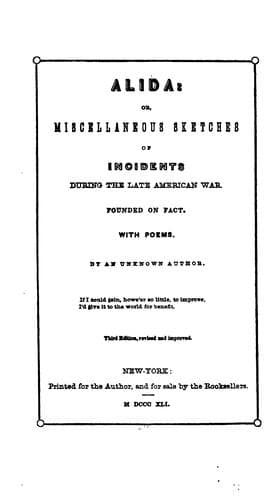
Alida; or, Miscellaneous Sketches of Incidents During the Late American War.: Founded on FactComfield, Amelia Stratton
History
Alida; or, Miscellaneous Sketches of Incidents During the Late American War.: Founded on Fact
Comfield, Amelia Stratton
United States -- History -- Revolution, 1775-1783 -- Juvenile fiction
From this unhappy period she remained at home a long time with her
father. In kindred grief there was derived a congenial sympathy, and her
society contributed in some degree to allay his sorrow, as the deep
concern he felt in her welfare caused him sometimes to restrain the flow
of it in her presence. Self-exertion roused him in a measure from his
lethargy, and by thus assuming serenity, to become in reality something
more composed. Nevertheless, he would often witness the excess of
anguish which had taken place in the bosom of his child, and behold her
interesting face bathed in tears, and her youthful brow clouded with a
sadness that nothing seemingly could dissipate.
[_NY Weekly_: Mrs. Mordaunt:
to me they were inexpressibly soothing, from kindred grief there
was derived a congenial sympathy.
...
Their happiness, the education of my child, and self-exertion,
roused me from the lethargy of grief, and diffused a calm over my
mind I never hoped to have experienced.]
His situation now became more sequestered than ever; he roamed in
solitude, or pleased himself in ranging through silent glens in
loneliness. His thoughts were absorbed in the gloomy experience of the
misery of a painful separation from a dear and beloved object; he wept
for her whose mild and winning graces had power to soften and illuminate
the darkest shades of life, or alleviate the distressful scenes of
adversity.
[[This unidentified paragraph about Alida's widowed father reads
like the description of a young romantic hero.]]
His mind was wholly absorbed in those gloomy reflections that scarcely
admitted a ray of consolation, when the weekly newspaper arrived from
the neighbouring village; he took it up, hoping to find something to
amuse his thoughts; he opened it to read the news of the day; he ran his
eye hastily over it, and was about to lay it aside, "when the death list
arrested his attention by a display of broad black lines," and he, who
had not yet become reconciled to his present misfortune, was now about
to experience another equally severe.
[_A&M_ (Alonzo reads of Melissa's death):
He returned, and as he was entering the door he saw the weekly
newspaper of the town, which had been published that morning, and
which the carrier had just flung into the hall. The family had not
yet arisen. He took up the paper, carried it to his chamber, and
opened it to read the news of the day. He ran his eye hastily over
it, and was about to lay it aside, when the death list arrested his
attention, by a display of broad black lines.]
What could equal his bitterness, his surprise and grief, when he read
the disastrous news that his youngest son (who had lately gone on a
foreign expedition) had died of a fever in a distant land a few weeks
previous!
Public-domain text, read in full here on John Shaqi.
Reviews
Reviews
No reviews yet
Be the first to share your thoughts on this work.
Elsewhere in the archive
Join the Discussion
Join the discussion
Sign in to leave a comment or review.
Sign InorCreate an account