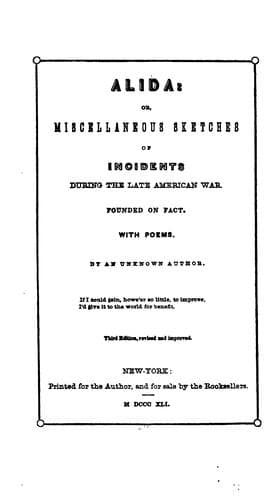
Alida; or, Miscellaneous Sketches of Incidents During the Late American War.: Founded on FactComfield, Amelia Stratton
History
Alida; or, Miscellaneous Sketches of Incidents During the Late American War.: Founded on Fact
Comfield, Amelia Stratton
United States -- History -- Revolution, 1775-1783 -- Juvenile fiction
We left Schenectady early in the morning on board the packet-boat
Samuel Young, which had engaged to take us to Utica, eighty miles
distant, by an early hour the next day. It was a large boat, and, as
the passengers are obliged to spend the night on board, is provided
with separate apartments for the ladies. The canal again ran along
the well-cultivated valley of the Mohawk, and the country, on
account of the foliage of the trees upon the heights was beautiful.]
The village of Amsterdam consists of a few neat houses. The canal is
carried over two rivers, called Schoharie, Canajoharie, from which it
receives the most of its water. At this place the horses were conveyed
to the opposite side of the two rivers by means of a ferry-boat. At the
first ferry is a small village, called Fort Hunter, where at the time of
the revolution there had been a fort, or rather a redoubt of the same
name. Towards evening they passed through a valley, which is formed by
two rocky mountains. There are twenty locks between Schenectady and
Utica. The day was intolerably warm, and the company very much oppressed
by the heat, but in the evening fortunately there was a thunder-shower,
which cooled the air. They passed over an aqueduct bridge during the
night, which stands over a solace called Little Falls.
[_Travels_:
The village of Amsterdam consists of a few neat houses; and
opposite, on the right bank of the Mohawk, is Rotterdam. On our way
we passed several small aqueducts, the longest of which rest only
upon three piers, and extend over small brooks, which, as well as
the small rivulets, are distinguished by the Indian appellation of
"creek." The canal is carried over two rivers, called Schoharie and
Canajoharie creeks, from which it receives the most of its water. At
this place the horses are conveyed to the opposite side of the two
rivers by means of ferryboats. At the first ferry is a small
village, called Fort Hunter, where, before the revolution, there had
been a fort, or rather a redoubt of the same name. Towards evening
we passed through a valley, which is formed by two rocky mountains,
one of which is called Anthony's Nose. The houses we saw on our
route, had generally a handsome appearance; to-day and yesterday I
observed also some saw-mills. There are twenty-six locks between
Schenectady and Utica. The day was intolerably warm, and our company
was very numerous. I confined myself to writing, the whole day, as
much as possible; but, in consequence of the heat, I could not avoid
sleeping. In the evening we fortunately had a thunder-storm, which
cooled the air.... During the night we passed an aqueduct bridge,
which stands over a solace, called Little Falls.]
Public-domain text, read in full here on John Shaqi.
Reviews
Reviews
No reviews yet
Be the first to share your thoughts on this work.
Elsewhere in the archive
Join the Discussion
Join the discussion
Sign in to leave a comment or review.
Sign InorCreate an account