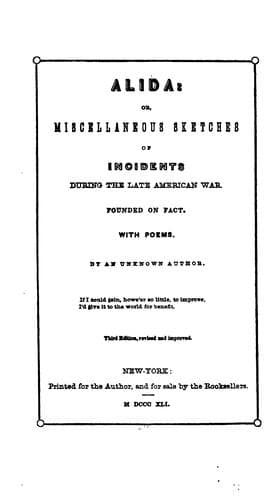
Alida; or, Miscellaneous Sketches of Incidents During the Late American War.: Founded on FactComfield, Amelia Stratton
History
Alida; or, Miscellaneous Sketches of Incidents During the Late American War.: Founded on Fact
Comfield, Amelia Stratton
United States -- History -- Revolution, 1775-1783 -- Juvenile fiction
On the morning of the 14th of August they took passage on board of the
Albany, one of the canal packet-boats, for Lake Erie. This canal, which
is three hundred and sixty-two miles in length, with eighty-three locks
between the Hudson river and Lake Erie, which lies six hundred and
eighty-eight feet above the level of the former river. The packet-boat
took them from thence to Schenectady. It was covered, and contained a
spacious cabin. On account of the great number of the locks, the
progress of their journey was but slow. The boat was drawn by three
horses, that walked upon a narrow path leading along the canal, and
beneath the numerous bridges which are thrown over it.
The distance from Albany to Schenectady by land is only fifteen miles,
and persons are enabled to travel it in a very short time in a stage
coach, but as they were anxious to see the canal, they preferred going
by water twenty-eight miles.
The city of Troy, five miles and a half above Albany, is pleasantly
situated on the left bank of the river, at the foot of several tolerably
high mountains, one of which is called Mount Ida. There is a branch
canal, which has two locks, and establishes a communication with Troy.
They soon arrived at a place where there were no less than nine locks,
with an ascent of seventy-eight feet. In front, and to the right of
this, is another canal, which unites with the Hudson and the canal from
Lake Champlain. At this place they left the Hudson, and directed their
course along the Mohawk river. During their ride, they observed a
covered wooden bridge, which extends over the latter river, a short
distance from its mouth, and is about six hundred feet in length,
supported by fifteen wooden piers. There was a fine view of the famous
Cohoes Falls of the Mohawk river, seventy-eight feet in height, and
about four hundred feet wide. In the spring, when these falls extend
over the entire bed of the Mohawk, they are said to be extremely
magnificent. During this season of dry weather, they presented a
handsome appearance, though they were very small, the river being almost
completely dried up. Finding great difficulty in continuing the canal on
the right bank of the Mohawk, they were obliged here to carry it to the
opposite side of the river by means of an aqueduct bridge one thousand
one hundred and eighty-eight feet in length. This bridge is supported by
twenty-six stone columns, on which account they have placed a
chevaux-de-frieze to keep off the ice in the river. The canal is cut
through the rocks almost the whole distance, where it runs along the
left bank of the Mohawk, and presents a very handsome appearance. Twelve
miles further on, it returns again to the right bank of the river, by a
similar aqueduct, supported by sixteen piers. Four miles farther on is
Schenectady, where they arrived after sunset. Between this town and
Albany they passed no less than twenty-seven locks. At this place they
Public-domain text, read in full here on John Shaqi.
Reviews
Reviews
No reviews yet
Be the first to share your thoughts on this work.
Elsewhere in the archive
Join the Discussion
Join the discussion
Sign in to leave a comment or review.
Sign InorCreate an account