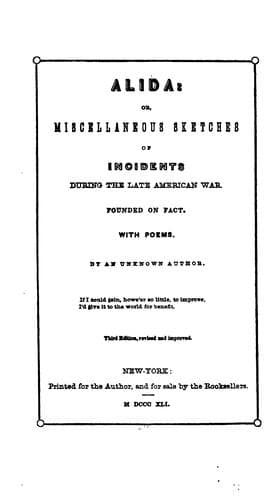
Alida; or, Miscellaneous Sketches of Incidents During the Late American War.: Founded on FactComfield, Amelia Stratton
History
Alida; or, Miscellaneous Sketches of Incidents During the Late American War.: Founded on Fact
Comfield, Amelia Stratton
United States -- History -- Revolution, 1775-1783 -- Juvenile fiction
At eight o'clock next morning they took passage on board the steam-boat,
to go down the river as far as the town of Catskill, at the foot of Pine
Orchard. The company ascended the mountain, which is twelve miles high,
in stages. They reached Pine Orchard a little before sunset. The
building on the mountain for the accommodation of visiters, is a
splendid establishment. Alida was truly delighted with the landscape it
presented in miniature; where large farms appeared like garden spots,
and the Hudson a rivulet, and where sometimes the clouds were seen
floating beneath the eye of the spectator.
The next morning they again took the steam-boat at Catskill to go to
Hudson, twenty-seven and a half miles from Albany, which they reached
about noon. This city appears very handsome and lively. On the opposite
side of the river is Athens, between which and Hudson there seems to be
much communication kept up by a team-boat. A very low island in the
middle of the stream between the two places, rendered this communication
somewhat difficult at first, as vessels were obliged to make a great
circuit. To avoid this inconvenience, a canal was cut through the
island, through which the team-boat now passes with ease and rapidity.
This place affords a very fine view of the lofty Catskill mountains.
They left the city of Hudson in the afternoon, and arrived at West Point
at eleven o'clock at night, on the right side of the Hudson, and landed
at a wharf furnished with a sentry-box. An artillerist stood sentinel.
They were obliged to ascend a somewhat steep road in order to reach the
house which is prepared for the reception of strangers. The building
belongs to the government, and is designed for the mess-room of the
officers and cadets. The purveyor for this table is bound by contract
with the government to keep several chambers with beds in order for the
reception of the relations of the cadets.
The morning after their arrival, the gentlemen paid an early visit to
lieutenant-colonel Thayer, superintendent of the military school, and
were received in a very friendly manner. He had presided over this
school several years. Colonel Thayer has entirely remodelled this
institution, and very much improved it.
The cadets, whose number may amount to two hundred and fifty, are
divided into four classes for the purposes of instruction. They are
received between the ages of fourteen and twenty, and must undergo an
examination before they enter.
Instruction is communicated gratuitously to the cadets, each of whom
receives monthly eight dollars from government as wages.
A public examination of the cadets takes place every year at the end of
June, by a commission appointed by the Secretary of War. This commission
consists of staff officers from the army and navy, members of Congress,
governors of states, learned men and other distinguished citizens. After
this examination, the best among those who have finished their course
are appointed as officers in the army.
Public-domain text, read in full here on John Shaqi.
Reviews
Reviews
No reviews yet
Be the first to share your thoughts on this work.
Elsewhere in the archive
Join the Discussion
Join the discussion
Sign in to leave a comment or review.
Sign InorCreate an account