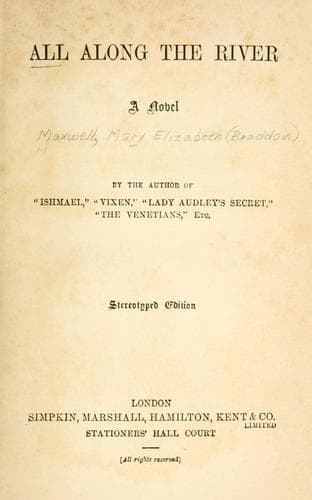
All along the River: A NovelBraddon, M. E. (Mary Elizabeth)
General
All along the River: A Novel
Braddon, M. E. (Mary Elizabeth)
English fiction -- 19th century
The early western harvest had been gathered in. Upland and valley in
that undulating land were clothed with the tawny hue of the stubble.
Here and there the plough horses were moving slowly along the red
ridges on the steep hillside. No touch of frost had dulled the rich
hues of the autumnal flowers, and the red carnations still glowed in
every cottage garden, while the pale pink trusses of hydrangea filled
all the shrubberies with beauty. A keener breath came up at eventide
from the salt sea beyond Point Neptune, and wilder winds crept across
the inland valleys with the on-coming of night. Summer and the swallows
were gone. October, a balmy season for the most part, was at hand;
and there were no more tea-drinkings and afternoon gossipings in the
garden at the Angler’s Nest. The lamps were lighted before dinner. The
evenings were spent in the old library and the new drawing-room, the
new room communicating with the old one by a curtained archway, so that
of a night the curtains could be drawn back and Martin Disney could
sit among his books by the fireplace in the library, and yet be within
conversational reach of Isola and Allegra in the drawing-room, where
they had piano and table-easel, work-baskets, and occupations of all
kinds.
Mr. Colfox sometimes dropped in of an evening, on parish business of
course, took a cup of coffee, listened while Allegra played one of
Mozart’s sonatas or sang a song by Gluck or Haydn or Handel. Mr. Colfox
was not one of the advanced people who despise Mozart or Handel. Nor
did he look down upon Haydn. Indeed, he sat and stroked his thin legs
with a sheepish appreciation, wrinkling up his loose trousers, and
showing a large amount of stocking, while Allegra sang “My mother bids
me bind my hair,” in her clear, strong mezzo-soprano, which was of
infinite use to him in his choir.
He told everybody that Martin Disney’s was an ideal household--a home
into which it was a privilege to be admitted.
“I feel as if I never knew the beauty of domestic life till I knew the
Angler’s Nest,” he said one evening after dinner at Glenaveril, when
he and the village doctor had accepted one of Mr. Crowther’s pressing
invitations to what he called “pot-luck,” the pot-luck of the man whose
spirit burns within him at the thought of his hundred-guinea cook, and
whose pride is most intolerable when it apes humility.
“Really, now,” said Mr. Crowther, “you surprise me, for I have always
fancied there was a screw loose there.”
“What does that expression imply, Mr. Crowther?” asked the curate,
coldly.
“Oh, I don’t know! Nothing specific: only one’s notion of an ideal home
doesn’t generally take the shape of a beautiful girl of twenty married
to a man of forty-five. The disparity is just twice as much as it ought
to be.”
“Upon my soul,” cried the curate, “I don’t believe that wedded love is
affected by any difference of years. Desdemona loved Othello, who was a
man of mature age----”
Public-domain text, read in full here on John Shaqi.
Reviews
Reviews
No reviews yet
Be the first to share your thoughts on this work.
Elsewhere in the archive
Join the Discussion
Join the discussion
Sign in to leave a comment or review.
Sign InorCreate an account