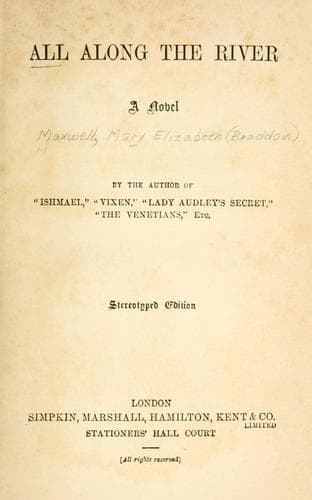
All along the River: A NovelBraddon, M. E. (Mary Elizabeth)
General
All along the River: A Novel
Braddon, M. E. (Mary Elizabeth)
English fiction -- 19th century
“I don’t know why you never come to see me,” said Mrs. Crowther,
confidentially, having made room for Isola upon a very pretentious and
uncomfortable sofa of the cabriole period, a sofa with a sloping seat
and a stately back in three oval divisions, heavily framed in carved
walnut, a back against which it was agony to lean, a seat upon which it
was martyrdom to sit. “But I don’t see why we shouldn’t be friends when
we do happen to meet.”
“Dear Mrs. Crowther, we are always friends. I shall never forget your
kindness to me.”
“There, there; you’re a tender-hearted soul, I know. It grieved me so
not to go and see you when you were ill; and not to pay attention to
your baby. Such a sweet little fellow, too. I’ve given him many a kiss
on the sly when I’ve met him and his nurse in the lanes. I suppose Mr.
Crowther and the colonel don’t hitch their horses very well together.
That’s at the bottom of it all, no doubt. But as for you and me, Isola,
I hope we shall always be good friends.”
This confidential talk between the two women, observed by Mrs. Baynham
out of the corner of her eye, augured well; but Mr. Crowther had not
left off glaring, and a glare in those protruding eyeballs was awful.
He usurped the hearthrug, as he laid down the law about the political
situation and the impending ruin of the country.
“A feeble policy never maintained the prestige of any country, sir,”
he told Captain Pentreath, the half-pay bachelor, who was devoted
to fishing, and cared very little whether his country had prestige
or shuffled on without it--so long as fish would bite. “We lost our
prestige when we lost Beaconsfield, and with our prestige we are
losing our influence. The Continental powers leave us out of their
calculations. The neutral policy of the last ten years has stultified
the triumph of British arms from Marlborough to Wellington. The day
will come, sir, when the world will cease to believe in the history
of those magnificent campaigns. People will say, ‘These are idle
traditions. England could never have been a warlike nation.’”
Captain Pentreath tried to look interested, but was obviously
indifferent to the opinion of future ages, and intent upon watching
Allegra, looking her handsomest in a yellow silk gown, and deep in talk
with Captain Hulbert, who leant his tall form against Mrs. Baynham’s
cottage piano, which, with a view to artistic effect, had been
disguised in Algerian drapery, and wheeled into a position that made
the room more difficult of navigation.
One only of the rosy-cheeked nieces was allowed to appear at the
dinner-table; firstly because the table was a tight fit for twelve, and
secondly because a thirteenth would have excited superstitious fears.
The younger sister, whom people asked about with tender solicitude,
was to be on view afterwards, when she would perform the bass to her
sister’s treble in the famous overture to Zampa, which, although not
exactly a novelty, may be relied upon to open a musical evening with
_éclat_.
Public-domain text, read in full here on John Shaqi.
Reviews
Reviews
No reviews yet
Be the first to share your thoughts on this work.
Elsewhere in the archive
Join the Discussion
Join the discussion
Sign in to leave a comment or review.
Sign InorCreate an account