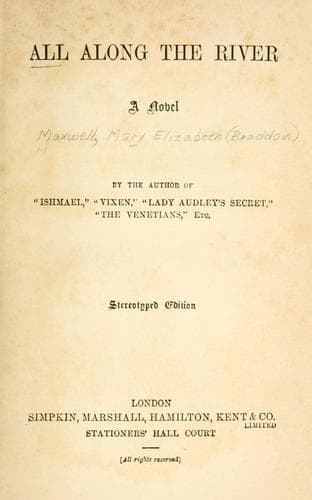
All along the River: A NovelBraddon, M. E. (Mary Elizabeth)
General
All along the River: A Novel
Braddon, M. E. (Mary Elizabeth)
English fiction -- 19th century
“I am looking at you to see if you are the woman I have loved and
believed in, or if you are as false as hell,” he said, with his strong
hand grasping her shoulder, her face turned to his, so that those
frightened eyes of hers could not escape his scrutiny.
“Who has put this nonsense in your head?”
“Your neighbour--your good Mrs. Crowther’s husband--told me that his
lawyer travelled with you from Paddington--on the 31st of December--the
year before last. He got into conversation with you--you remember,
perhaps?”
“No,” she cried, with a sudden piteous change in her face, “I can’t
remember.”
“But you came from London on that day. You remember that?”
“Yes, yes. I came from Gwendolen’s house on that day. I told you so in
my letter.”
“That letter which I never received--telling me of that visit to which
you made no allusion in any of your later letters. It was about that
time, I think, that you fell off as a correspondent--left off telling
me all the little details of your life--which in your earlier letters
seemed to shorten the distance between us.”
She was silent, listening to his reproaches with a sullen dumbness,
as it seemed to him, while he stood there in his agony of doubt--in
his despairing love. He turned from her with a heart-broken sigh, and
slowly left the room, going away he scarce knew whither, only to put
himself beyond the possibility of saying hard things to her, of letting
burning, branding words flash out of the devouring fire in his heart.
She stood for a few moments after he had gone, hesitating, breathless,
and frightened, like a hunted animal at bay--then ran to the door,
opened it softly, and listened. She could hear him pacing the room
above. Again she stood still and hesitated, her lips tightly set, her
hands clenched, her brow bent in painful thought. Then she snatched hat
and jacket from a corner of the hall where such things were kept, and
put them on hurriedly, with trembling hands, as if her fate depended
upon the speed with which she got herself ready to go out, looking up
at the great, dim, brazen face of the eight-day clock all the while.
And then she let herself out at a half-glass door into the garden, and
walked quickly to a side gate that opened in to the lane--the gate at
which the baker and the butcher stopped to gossip with the maids on
fine mornings.
Public-domain text, read in full here on John Shaqi.
Reviews
Reviews
No reviews yet
Be the first to share your thoughts on this work.
Elsewhere in the archive
Join the Discussion
Join the discussion
Sign in to leave a comment or review.
Sign InorCreate an account