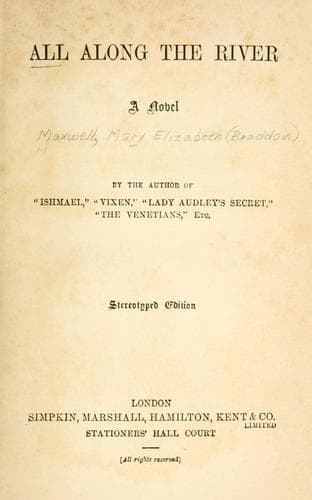
All along the River: A NovelBraddon, M. E. (Mary Elizabeth)
General
All along the River: A Novel
Braddon, M. E. (Mary Elizabeth)
English fiction -- 19th century
“It is sad; but the world is made so. And then Providence steeps
elderly people in a happy hallucination. They generally forget that
they are old; or at least they forget that they ever were young, and
they think young people so ineffably silly that youth itself seems
despicable to their sober old minds. But you and I have a long life
to the good, dear love, before the coming of grey hairs and elderly
prejudices.”
And then he began to talk of ways and means, as if they were going to
be married next week.
“We shall have enough for bread and cheese,” he said. “I am better
off than a good many younger sons; for a certain old grandfather of
mine provided for the younger branches. It is quite possible that
Lostwithiel may never marry--indeed, he seems to me very decided
against matrimony, and in that case those who come after us must
inherit title and estate in days to come.”
“Pray don’t talk so,” cried Allegra, horrified. “It sounds as if you
were speculating upon your brother’s death.”
“On Lostwithiel’s death? Not for worlds. God bless him, wherever he may
be. You don’t know how fond we two fellows are of each other. Only when
a man is going to be married it behoves him to think even of the remote
future. I shall have to talk to the colonel, remember; and he will
expect me to be business-like.”
“I hope you don’t think Martin mercenary,” said Allegra. “There never
was a man who set less value on money. It wouldn’t make any difference
to him if you had not a penny. And as for me, I have a little income
from my mother--more than enough to buy frocks and things--and beyond
that I can earn my own living. So you really needn’t trouble yourself
about me.”
There was a touching simplicity in her speech, mingled with a slight
flavour of audacity, as of an emancipated young woman, which amused her
lover, reminding him of a heroine of Murger’s, or Musset’s, a brave
little grisette, who was willing to work hard for the _ménage à deux_,
and who wanted nothing from her lover but love. He looked into the
candid face, radiant in the fire-glow, and he told himself that this
was just the one woman for whom his heart had kept itself empty, like
a temple waiting for its god, in all the years of his manhood. And now
the temple doors had opened wide, the gates had been lifted up, and the
goddess had marched to her place, triumphant and all-conquering.
The clock on the mantelpiece struck six, and the old eight-day clock in
the hall followed like a solemn echo. Captain Hulbert started up. “So
late! Why, we have been talking for nearly two hours!” he exclaimed,
“and I have a budget of letters to write for the night mail. Good-bye,
darling--or I’ll say _au revoir_, for I’ll walk down again after
dinner, and get half an hour’s chat with Disney, if you don’t think it
will be too late for me to see him.”
Public-domain text, read in full here on John Shaqi.
Reviews
Reviews
No reviews yet
Be the first to share your thoughts on this work.
Elsewhere in the archive
Join the Discussion
Join the discussion
Sign in to leave a comment or review.
Sign InorCreate an account