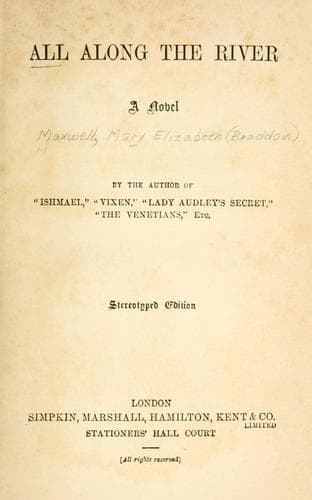
All along the River: A NovelBraddon, M. E. (Mary Elizabeth)
General
All along the River: A Novel
Braddon, M. E. (Mary Elizabeth)
English fiction -- 19th century
“Her mother was the sweetest and truest of women,” he said, “and her
father had one of the most refined and delicate natures I ever met
with in a man. I do not know that he was altogether fitted for the
Church. He was wanting in energy and decision, or force of character;
but he was a firm believer, pure-minded and disinterested, and he was
an artist to the tips of his fingers. It is from him Allegra inherits
her love of art; only while he was content to trifle with art she has
worked with all the power of her strong, resolute temperament. She
inherits that from her mother’s line, which was a race of workers, men
with whom achievement was a necessity of existence--men who fought, and
men who thought--sword and gown.”
Disney smiled at the stern condition of a year’s probation which
Allegra had imposed upon her lover.
“Such sentences are very often remitted,” he said.
“I own to having some hope of mercy,” replied Captain Hulbert. “People
have an idea that May marriages are unlucky; and perhaps we had better
defer to a popular superstition. But it seems to me that June is a
capital month for a yachtsman’s honeymoon; and if I can persuade my
dearest to remit half my period of probation, and fix the 1st of June
for our wedding, I should be just half a year happier than I am now.”
“Have you any notion yet what kind of life you are to lead after your
marriage? I hope it will not be a roving life. Isola and I would like
to have our sister near us.”
“And Allegra and I would like to study your liking,” laughed Hulbert.
“We may wander a little on summer seas, but we will have our fixed
abode, and it shall be near you. So long as Lostwithiel is a bachelor,
we can make our home at the Mount; but fond as I am of that dear old
place, I should be glad to see my brother married. There is something
amiss in his present mode of life; and I have but too strong reason to
fear that he is not a happy man.”
“Have you any idea of the cause of his unhappiness?”
“Only speculative ideas--mere theories that may be without foundation
in fact. I fancy that he has burnt the lamp of life a little too
furiously, and that the light has grown dim in the socket. The
after-taste of a fiery youth is the taste of dust and ashes. There may
be memories, too--memories of some past folly--which are bitter enough
to poison his life. I know that he is unhappy. I have tried to find out
the cause; and it all ends in this--an obstinate reserve on his part,
and mere theorizing on mine.”
“I have heard that he lived in a bad set after he left the University?”
Public-domain text, read in full here on John Shaqi.
Reviews
Reviews
No reviews yet
Be the first to share your thoughts on this work.
Elsewhere in the archive
Join the Discussion
Join the discussion
Sign in to leave a comment or review.
Sign InorCreate an account