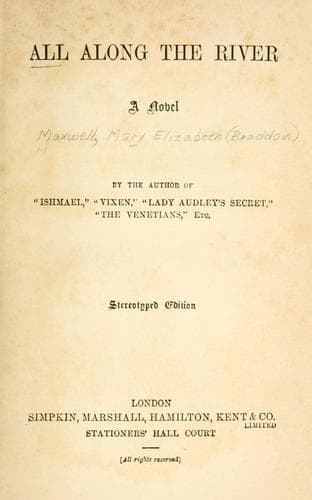
All along the River: A NovelBraddon, M. E. (Mary Elizabeth)
General
All along the River: A Novel
Braddon, M. E. (Mary Elizabeth)
English fiction -- 19th century
Martin Disney sat silent by his wife’s sofa. He could never hear
Lord Lostwithiel’s name without a touch of pain. His only objection
to Hulbert as a brother-in-law was the thought that the two men were
of the same race--that he must needs hear the hated name from time
to time; and yet he believed his wife’s avowal that she was pure and
true. His hatred of the name came only from the recollection that she
had been slandered by a man whom he despised. He looked at the wasted
profile on the satin pillow, so wan, so transparent in its waxen
pallor, the heavy eyelid drooping languidly, the faintly coloured
lips drawn as if with pain--a broken lily. Was this the kind of woman
to be suspected of evil--this fair and fragile creature, in whom the
spiritual so predominated over the sensual? He hated himself for having
been for a moment influenced by that underbred scoundrel at Glenaveril,
for having been base enough to doubt his wife’s purity.
He had pained and humiliated her, and now the stamp of death was on
the face he adored, and before him lay the prospect of a life’s remorse.
They left San Remo three days afterwards, Isola being pronounced able
to bear the journey, though her cough had been considerably increased
by that imprudent slumber in the wood. She was anxious to go; and
doctor and husband gave way to her eagerness for new scenes.
“I am so tired of this place,” she said piteously. “It is lovely; but
it is a loveliness that makes me melancholy. I want to be in a great
city where there are lots of people moving about. I have never lived in
a city, but always in quiet places--beautiful, very beautiful, but so
still--so still--so full of one’s self and one’s own thoughts.”
CHAPTER XXII.
ECCO ROMA.
The agent had proved himself worthy of trust, and had chosen the
lodging for Colonel Disney’s family with taste and discretion. It was a
first floor over a jeweller’s shop in a short street behind the Piazza
di Spagna, and under the Pincian Gardens. There were not too many
stairs for Isola to ascend when she came in from her drive or walk.
The gardens were close at hand, and all around there were trees and
flowers, and an atmosphere of verdure and retirement in the midst of
the great cosmopolitan city.
It was dark when the train came into the terminus; and Isola was weary
and exhausted after the long hot journey from Pisa, the glare of the
sun, and the suffocating clouds of dust, and the beautiful monotony
of blue sea and sandy plains, long level wastes, where nothing grew
but brushwood and osier, and stretches of marshy ground, with water
pools shining here and there, like burnished steel, and distant islets
dimly seen athwart a cloud of heat. Then evening closed in, and it was
through a grey and formless world that they approached the city whose
very name thrilled her.
Public-domain text, read in full here on John Shaqi.
Reviews
Reviews
No reviews yet
Be the first to share your thoughts on this work.
Elsewhere in the archive
Join the Discussion
Join the discussion
Sign in to leave a comment or review.
Sign InorCreate an account