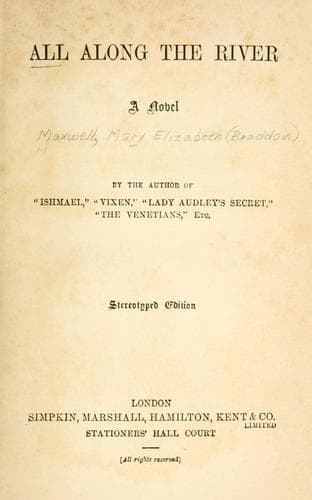
All along the River: A NovelBraddon, M. E. (Mary Elizabeth)
General
All along the River: A Novel
Braddon, M. E. (Mary Elizabeth)
English fiction -- 19th century
“Why should you grieve at the thought of their love? Is it because it
may please God to take you from them in the morning of your life? If it
is that dread which agitates you I entreat you to put it aside. There
is nothing in your case that forbids hope, and hope will do much to
help your recovery. You should tell yourself how valuable your life is
to those who love you. The thought of their affection should give you
courage to struggle against apathy and languor. Believe me, invalids
have their condition a great deal more in their own power than they
are inclined to believe. So much can be overcome where the spirit is
strong and brave, where faith and hope fight against bodily weakness.
You ought not to be sitting alone here in this saddening spot. It is
lovely, but with the beauty of death. You ought to be driving out to
Frascati or to Tivoli with your husband. You ought to be watching the
carriages in the Pincian Gardens, or amusing yourself in one of the
picture galleries.”
“I had rather be alone,” she said, wiping away her tears, and in some
degree recovering her self-possession.
“That is a morbid fancy, and one that hinders your recovery.”
“I have no wish to recover. I only want to die.”
“My dear Mrs. Disney, it is your duty to fight against these melancholy
moods. Can you be indifferent to your husband’s feelings? Have you not
the mother’s natural desire to watch over your child’s early years, to
see him reach manhood?”
“No, no, no!” she cried passionately. “I have had enough of life. They
are dear to me, very dear. No wife ever loved and honoured her husband
more than I love and honour mine--but it is all over, it is past, and
ended. I am more than resigned to death--I am thankful that God has
called me away.”
He watched her closely as she spoke, watched her with his hand upon
hers, which was cold as ice. He had heard such words before from the
early doomed, but they had been accompanied by religious exaltation;
they had been the outpouring of a faith that saw the gates of heaven
opened and the Son of man sitting in glory--of a love that longed to be
with God. Here there was no sign of hope or exaltation. There were only
the tokens of despair.
He remembered how agitated he had seen her many times in the
little church at San Remo, and how, although hanging eagerly upon
his preaching, she had persistently avoided anything like serious
conversation with him upon the few occasions when he had found himself
alone with her.
He had her Testament still in his hand, and looking down at the
tear-stained page it seemed to him that there lay the clue to her
melancholy.
“You have been reading the story of the woman of Samaria,” he said.
“Yes.”
“And you have read that other story of her who knelt in the dust at
her Saviour’s feet, and to whom He said, ‘Neither do I condemn thee.’”
“Yes.”
“Is there anything in either of those stories to sadden you more than
the thought of sin and sorrow saddens all of us?”
Public-domain text, read in full here on John Shaqi.
Reviews
Reviews
No reviews yet
Be the first to share your thoughts on this work.
Elsewhere in the archive
Join the Discussion
Join the discussion
Sign in to leave a comment or review.
Sign InorCreate an account