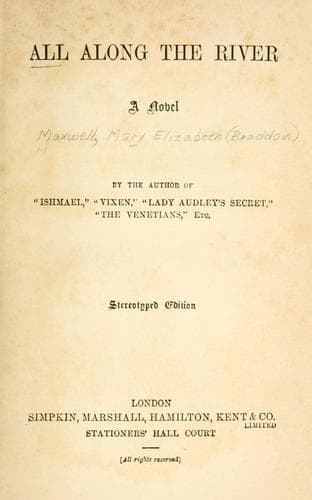
All along the River: A NovelBraddon, M. E. (Mary Elizabeth)
General
All along the River: A Novel
Braddon, M. E. (Mary Elizabeth)
English fiction -- 19th century
Isola went about looking at those things like a creature in a dream.
These stupendous tabernacles impressed her with an almost insupportable
sense of their magnitude. And with that awestricken sense of power in
the Christian Church there was interwoven the humiliating consciousness
of her own unworthiness; a consciousness sharpened and intensified by
every word that Father Rodwell had spoken in that agonizing hour of her
involuntary confession.
He was so kind to her, so gentle, so courteous in every word and act,
that she wondered sometimes whether he had forgotten that miserable
revelation; whether he had forgotten that she was one of the lost ones
of this earth, a woman who had forfeited woman’s first claim to man’s
esteem. Sometimes she found herself lifting her eyes to his face in an
unpremeditated prayer for pity, as they stood before some exquisite
shrine of the Madonna, and the ineffable purity in the sculptured face
looking down at her struck like a sharp sword into her heart. That mute
appeal of Isola’s seemed to ask, “Has the Mother of Christ any pity for
such a sinner as I?”
Colonel Disney was full of thoughtfulness for his wife in all their
going to and fro; and before their day’s rambles were half done he
would drive her to any quiet spot where she might choose to spend a
restful hour in the afternoon sunshine--in this or that convent garden,
in some shaded corner on the Aventine, or among the wild flowers that
flourish and grow rank amidst the ruins of palace and temple on the
Palatine. Her favourite resort was still the English cemetery, and she
always begged to be set down within reach of that familiar gate, where
the custodian knew her as well as if she had been some restless spirit
whose body lay under one of those marble urns, and whose ghost passed
in and out of the gate every day.
It was in vain that her husband or her sister offered to be her
companion in these restful hours. She always made the same reply.
“I am better alone,” she would say. “It does me good to be alone. I
don’t like being alone indoors--I get low-spirited and nervous--but I
like to sit among the flowers, and to watch the lizards darting in and
out among the graves. I am never dull there. I take a book with me; but
I don’t read much. I could sit there for hours in a summer dream.”
Martin Disney made a point of giving way to her will in all small
things. She might be capricious, she might have morbid fancies. That
was no business of his. It was his part to indulge her every whim, and
to make her in love with life. All that he asked of Heaven was to spin
out that attenuated thread. All that he desired was to hold her and
keep her for his own against Death himself.
Public-domain text, read in full here on John Shaqi.
Reviews
Reviews
No reviews yet
Be the first to share your thoughts on this work.
Elsewhere in the archive
Join the Discussion
Join the discussion
Sign in to leave a comment or review.
Sign InorCreate an account