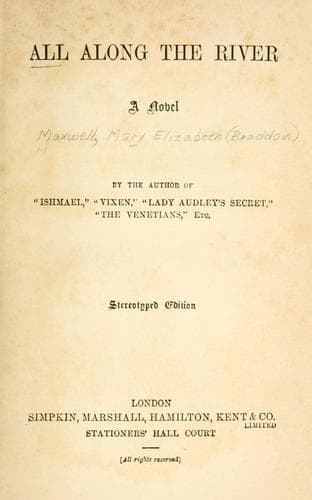
All along the River: A NovelBraddon, M. E. (Mary Elizabeth)
General
All along the River: A Novel
Braddon, M. E. (Mary Elizabeth)
English fiction -- 19th century
He resigned himself to his disappointment, talked no more of Venice
and the starlit lagunes, the summer nights on the Lido, and quoted no
more of Buskin’s rhapsodies; but he came meekly day after day to join
in the family excursion, whatever it might be. He had enough and to
spare of ecclesiastical architecture and of the old masters during
those summer-like mornings and afternoons. He heard more than enough of
the mad Cæsars and the bad Cæsars, of wicked Empresses and of low-born
favourites, of despotism throned in the palace and murder waiting at
the gate, of tyranny drunken with power long abused, and treason on the
watch for the golden opportunity to change one profligate master for
another, ready to toss up for the new Cæsar, and to accept the basest
slave for master, would be but open the Imperial treasury wide enough
to the Prætorian’s rapacious hands.
“People gloat over these hoary old walls as if they would like to have
lived under Caligula,” said the sailor, with a touch of impatience,
when Father Rodwell had been expatiating upon a little bit of moulding
which decorated an imperial staircase.
“It would have been at least a picturesque time to have lived in,” said
Allegra. “Existence must have been a series of pictures by Alma Tadema.”
Captain Hulbert was startled out of his state of placid submission by
the intervention of a most unexpected ally.
It was one of the hottest days there had been since they came to Rome.
To cross the Piazza in front of St. Peter’s was like plunging into a
bath of molten gold; while to enter the great Basilica itself was like
going into an ice-house. Father Rodwell was not with them upon this
particular morning. They were a party of four, and a roomy landau had
been engaged to take them to the Church of St. Paul beyond the walls,
and thence to the tomb of Cecilia Metella. Isola and Allegra had made
pilgrimages to the spot before to-day. It was a drive they both loved,
a glimpse of the pastoral life outside the gates of the city, and a
place for ever associated with the poet whose verse was written in
their hearts.
They dawdled over a light luncheon of macaroni and Roman wine at a
_café_ near the great cold white church, and then they drove through
the sandy lanes in the heat of the afternoon, languid all of them, and
Isola paler and more weary-looking than she had been for some time. Her
husband watched her anxiously, and wanted to go back to Rome, lest the
drive should be too exhausting for her.
“No, no, I am not tired,” she answered impatiently. “I would much
rather go on. I want to see that grim old tower again,” and then she
quoted the familiar lines, dreamily, with a faint pleasure in their
music--
“Perchance she died in youth: it may be bowed
With woes far heavier than the ponderous tomb
That weighed upon her gentle dust.”
Public-domain text, read in full here on John Shaqi.
Reviews
Reviews
No reviews yet
Be the first to share your thoughts on this work.
Elsewhere in the archive
Join the Discussion
Join the discussion
Sign in to leave a comment or review.
Sign InorCreate an account