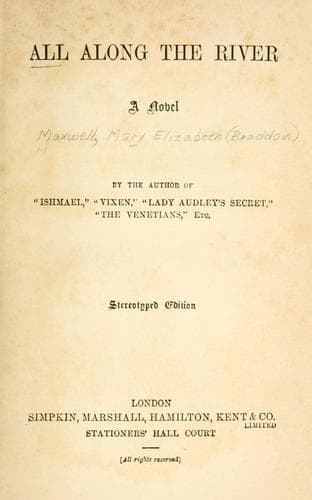
All along the River: A NovelBraddon, M. E. (Mary Elizabeth)
General
All along the River: A Novel
Braddon, M. E. (Mary Elizabeth)
English fiction -- 19th century
This young person had the honour to bring the trousseau which Monsieur
had sent for Madame’s inspection. Monsieur had told her how sadly
inconvenienced Madame had been by the accident by which all her luggage
had been left upon the quay at the moment of sailing. In truth it must
have been distressing for Madame, as it had evidently been distressing
for Monsieur in his profound sympathy with Madame, his wife. In the
meantime she, the young person, had complied with Monsieur’s orders,
and had brought all that there was of the best and most delicate and
refined for Madame’s gracious inspection.
The cabin-boy brought in the two baskets, which the milliner opened
with an air, taking out the delicate lingerie, the soft silk and softer
cashmere--peignoirs, frilled petticoats, a fluff and flutter of creamy
lace and pale satin ribbons, transforming simplest garments into things
of beauty. She spread out her wares, chattering all the while, and then
looked at Madame for approval.
Isola scarcely glanced at all the finery. She pointed to the only
plain walking-gown among all the delicate prettinesses, the silks and
cashmeres and laces--a grey tweed tailor-gown, with no adornment
except a little narrow black braid.
“I will keep that,” she said, “and one set of under-linen, the
plainest. You can take all the rest of the things back to your shop.
Please help me to dress as quickly as you can--I want to go on shore in
the boat that takes you back.”
“But, Madame, Monsieur insisted that I should bring a complete
trousseau. He wished Madame to supply herself with all things needful
for a long cruise in the south.”
“He was mistaken. My luggage is safe enough. I shall have it again in a
few days. I only want clothes to wear for a day or two. Kindly do what
I ask.”
Her tone was so authoritative that the milliner complied, reluctantly,
and murmuring persuasive little speeches while she assisted Madame to
dress. All that she had brought was of the most new--expressly arrived
from Paris, from one of the most distinguished establishments in the
Rue de la Paix. Fashions change so quickly--and the present fashions
were so enchanting, so original. She must be pardoned if she suggested
that nothing in Madame’s wardrobe could be so new or so elegant as
these latest triumphs of an artistic _faiseur_. Madame took no heed of
her eloquence, but hurried through the simple toilet, insisted upon all
the finery being replaced in the two baskets, and then went upon deck
with the milliner.
“I am going on shore to his lordship,” she said, with quiet authority,
to the captain.
It was a deliberate lie--the first she had told, but not the last she
would have to tell.
Public-domain text, read in full here on John Shaqi.
Reviews
Reviews
No reviews yet
Be the first to share your thoughts on this work.
Elsewhere in the archive
Join the Discussion
Join the discussion
Sign in to leave a comment or review.
Sign InorCreate an account