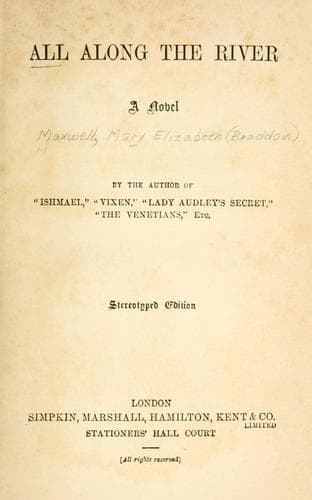
All along the River: A NovelBraddon, M. E. (Mary Elizabeth)
General
All along the River: A Novel
Braddon, M. E. (Mary Elizabeth)
English fiction -- 19th century
Tabitha came in from the adjoining bedroom every now and then, and
adjusted the pillows on the sofa, and sprinkled eau de Cologne, or
fanned the invalid with a large Japanese fan, or arranged the silken
coverlet over her feet, or brought her some small refreshment in the
way of a cup of soup or jelly, and tenderly coaxed and assisted her to
take it, talking just as much or as little as seemed prudent, always
careful neither to fatigue nor excite her charge.
* * * * *
It was between eight and nine in the evening, and there was a gloomy
twilight in the loggia, and in the garden beyond. The wind which had
dropped in the afternoon had begun to rage again, as if not only Nero
but all the wicked emperors were abroad in the air.
Isola had begged that one of the windows might be opened, in spite of
the tempestuous weather; and the cold damp breath of the storm crept
into the room and chilled Martin Disney as he sat by his wife’s sofa,
reading a London paper that had come by the evening post.
The only artificial light in the room was a reading-lamp at the
colonel’s elbow, shaded from the draught by the four-leaved screen
which protected the invalid. The gloomy grey daylight had not quite
faded, and through the half-open door opposite him Martin Disney saw
the white marble wall of the staircase, and some oleanders in stone
vases that stood on the spacious landing.
He had been reading to Isola nearly all day. He was reading to himself
now, trying to forget his own grief in the consideration of a leading
article which prophecied a European war, and the ultimate extinction of
English influence in continental politics.
There was perfect stillness in the room. Isola had been lying with
closed eyes a little time before, and he fancied that she was sleeping.
The silence had lasted for nearly an hour, broken only by the shriek
of the wind, and by the chiming of the quarters from the Church of La
Trinità de’ Monti, when Colonel Disney was startled by his wife’s hand
clutching his arm, and his wife’s agitated whisper sounding close to
his ear.
“Martin! Did you see him?”
She had lifted herself into a sitting position, she who had not been
able to sit up for many days past.
The hectic bloom had faded from her cheeks and left them ashy pale. Her
eyes seemed almost starting from her head, straining their gaze as if
to penetrate the deepening shadows on the landing beyond the half-open
door.
“My love, you have been dreaming,” said Disney, soothing her with
womanly gentleness. “Lie down again, my poor dear. See, let me arrange
the pillows and make you quite comfortable.”
“No, no! I was not dreaming. I have not been asleep. He was there. I
saw him as plainly as I see you. He pushed the door a little further
open and looked in at me. I saw his face in the lamplight, very pale.”
Public-domain text, read in full here on John Shaqi.
Reviews
Reviews
No reviews yet
Be the first to share your thoughts on this work.
Elsewhere in the archive
Join the Discussion
Join the discussion
Sign in to leave a comment or review.
Sign InorCreate an account