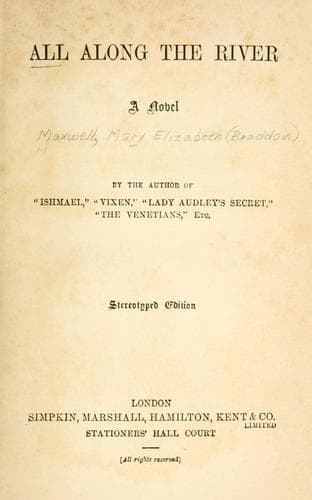
All along the River: A NovelBraddon, M. E. (Mary Elizabeth)
General
All along the River: A Novel
Braddon, M. E. (Mary Elizabeth)
English fiction -- 19th century
She was gone. That page of his life was closed for ever. And now he
had but one purpose and one desire--to settle his account with the
scoundrel who had destroyed her. He had waited till she was at rest:
and now the long agony of waiting was over. Nothing could touch _her_
more; and he was free to bring her seducer to book.
He had telegraphed in the morning to Captain Hulbert at Venice, but
there had been no reply so far; and he could only suppose that Allegra
and her husband had left the city upon one of those excursions which
his sister had described to him as diversifying their quiet life in
their palace on the grand canal. He had not been at home long, and
his tired eyes were still dazed and blinded by the flood of sunlight
which the servants had let in upon the rooms after the funeral, when a
telegram was brought to him.
It was from Brindisi.
“The _Eurydice_ went down with all hands last night, off Smyrna. My
brother was on board. I am on my way to Greece. If you can be spared go
to Allegra.--Hulbert.”
Martin Disney knew later that it was between eight and nine o’clock
that the _Eurydice_ struck upon a rock, and every soul on board her
perished.
* * * * *
The boy and his nurse went back to Trelasco under Tabitha’s escort,
and they were followed to Cornwall soon afterwards by the new Lord
Lostwithiel and his wife, who established themselves at the Mount, to
the great satisfaction of the neighbourhood, where it was felt that
the local nobleman had again become a permanent institution. Allegra
and her husband took Martin Disney’s son under their protection in the
absence of his father, who carried a heavy heart back to the jungle and
the tent, trying to find distraction and forgetfulness in the pursuit
of big game, and who did not revisit the Angler’s Nest till two years
after his wife’s death, when he returned to live a tranquil life among
the books in the library which he had built for himself, and to watch
the growth of his son, whose every look and tone recalled the image of
his dead wife. Sometimes, on drowsy summer afternoons, smoking his pipe
under the tulip tree, while the Fowey river rippled by in the sunshine,
it seemed to him as if Isola’s pensive loveliness, and the years that
he had lived with her, and the tears that he had shed for her, and the
infinite pity which had blotted out all sense of his deep wrong, were
only the transient phases of a long sad dream--the dream of a love that
never was returned.
“And yet, and yet,” he said to himself, after lengthened meditation,
with unseeing eyes fixed upon the movement of the tide, “I think she
loved me. I think her heart was mine from the hour her tears welcomed
me back to this house, until her last sigh. God help all young wives
whom their husbands leave alone in their youth and beauty to stand or
fall in the hour of temptation!”
* * * * *
Public-domain text, read in full here on John Shaqi.
Reviews
Reviews
No reviews yet
Be the first to share your thoughts on this work.
Elsewhere in the archive
Join the Discussion
Join the discussion
Sign in to leave a comment or review.
Sign InorCreate an account