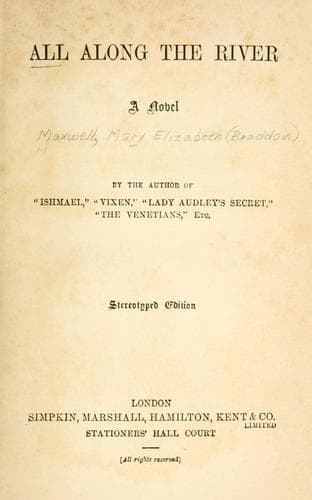
All along the River: A NovelBraddon, M. E. (Mary Elizabeth)
General
All along the River: A Novel
Braddon, M. E. (Mary Elizabeth)
English fiction -- 19th century
It was early summer, summer in her first youth, when she is frivolous
and capricious, laughs and weeps she knows not why; smiling through
her tears, and never knowing her own mind for a week together; to-day
gracious-tempered and tropical; to-morrow east-windy and morose. In
a word, it was June, a season of roses and rains, blue skies and
thunder-clouds. It was June, and Martin Disney was looking out of the
window with a keen eager face, much bronzed, and somewhat haggard,
after a fatiguing campaign, looking out across the vales and woods of
his native county, as the Penzance train sped along the high-level line
betwixt Plymouth and Par. Those keen, grey eyes of his, accustomed to
searching out far-off objects, looked as if they could pierce through
the green heart of the Cornish valleys to the sheltered little harbour
of Fowey and the blue sea that opened wide to the far-off West.
His labours were over, and he was going to take his rest, going to hang
up his sword, that sword which had done such good work, or to transform
it into a reaping-hook. He was Colonel Disney now, had given the State
his best service, and now, in the very prime and vigour of his manhood,
the State had done with him, and he was free to do what he listed with
the maturer half of his life. He would have been very sorry to retire
from active service had it not been for that tender tie which gave such
sweetness to the thought of retirement and tranquil days. He was going
home. The word thrilled him like music; home to his fair young wife,
his chosen one, his domestic divinity. He had not left off wondering
how it had ever come to pass that so young and fair a creature could
care for him.
“It isn’t as if I were one of your accomplished fellows,” he said to
himself, “able to sing, or play the flute, or paint in water-colours.
Except a very earnest love of a few good books, I have no culture. How
can any girl in the present day care for a man without culture? I could
never appreciate Keats, for instance; and not to appreciate Keats is to
be an outsider in literature.”
Yet, in spite of his seven and forty years, in spite of his
deficiencies, his homeliness, that young heart had gone out to him.
She loved him, and his lot was full. There was nothing more upon
God’s earth that he could desire, were it not a miracle, and that the
mother he had so fondly loved might be given back to him, to share his
happiness, to make the third in a trinity of trusting love. Since that
could not be, there was nothing left for him to yearn for.
Public-domain text, read in full here on John Shaqi.
Reviews
Reviews
No reviews yet
Be the first to share your thoughts on this work.
Join the Discussion
Join the discussion
Sign in to leave a comment or review.
Sign InorCreate an account