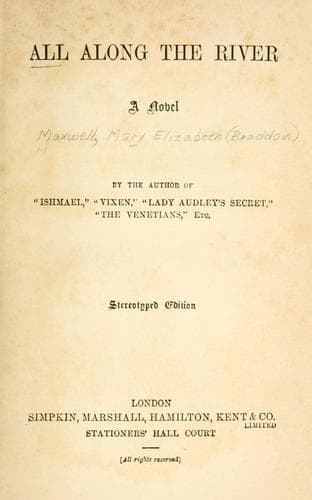
All along the River: A NovelBraddon, M. E. (Mary Elizabeth)
General
All along the River: A Novel
Braddon, M. E. (Mary Elizabeth)
English fiction -- 19th century
The beating of his heart quickened almost unbearably, as the train drew
near Par. Isola would meet him at the Junction, perhaps. He had not
announced the actual hour of his arrival, for matters had been a little
uncertain when he wrote yesterday, and he had not cared to telegraph
this morning before he left Paddington. Yet she would know that this
was the only likely train for him to choose; and she would be at the
Junction, he thought, smiling her glad welcome, a fair young face,
rosy in the sunset; for it was evening as he drew near the end of his
journey.
No; there was nobody he knew at the Junction. He walked up and down the
platform, and stared about him in rather a forlorn way during the few
minutes before the starting of the train for Fowey. She had not come to
anticipate their meeting by an hour or so, as he had hoped, as he had
felt almost certain, she would come.
It was more natural that she should wait and receive him at the
Angler’s Nest, he told himself, sitting in the corner of the railway
carriage presently, in a train of three coaches, steaming through the
pretty picturesque country between Par and Fowey. In the colder light
of reason it seemed preposterous to have expected to see her at the
Junction. She would like to welcome him amidst her own surroundings,
in the home to which she had doubtless given those little beautifying
touches in honour of his coming, which are such delight to women, and
which sometimes pass altogether unobserved by that pachydermatous
animal, man! How slowly the engine moved along that little bit of
line! Martin Disney sat with his face to the wind, and snuffed the sea
breeze as if it had been the odour of home. He thought of Ulysses,
and his return from distant lands. Would Tim, the fox terrier, know
him? and Shah, the Persian cat? Perhaps not. Tim was no Argus; vastly
affectionate and demonstrative, but not a dog to expire at one’s
feet, in the rapture of his master’s return. Penelope would know him,
and welcome him. That was enough for this modern Ulysses, who had no
reason to disguise himself in re-entering his home--who had no fear
of rival suitors, or interlopers of any kind. Penelope would welcome
him, and trusty Tabitha. He thought of the old servant’s honest face
with delight. She was something left to him out of boyhood and youth.
He felt like a young man when he talked to her. She was the one strong
link betwixt the present and the past. She was his memory embodied.
He could refer to her as to a dictionary of days long gone. When did
we do such and such a thing--or go to such a place? What was the name
of the bay horse I bought at Plympton? Where did my mother pick up the
Sheraton secretaire? Tabitha could answer all such trivial questions:
and Tabitha could talk to him for hours of his mother’s words and
ways--of the things that were only history.
Public-domain text, read in full here on John Shaqi.
Reviews
Reviews
No reviews yet
Be the first to share your thoughts on this work.
Elsewhere in the archive
Join the Discussion
Join the discussion
Sign in to leave a comment or review.
Sign InorCreate an account