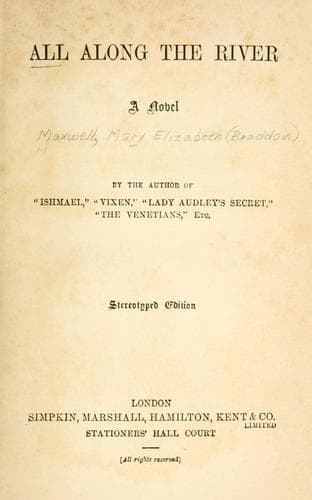
All along the River: A NovelBraddon, M. E. (Mary Elizabeth)
General
All along the River: A Novel
Braddon, M. E. (Mary Elizabeth)
English fiction -- 19th century
“There is just this one advantage in bad cooking at home that it makes
one so thoroughly enjoy everything one gets abroad,” he said, laughing
at his own prowess.
“I’ll try and get a better cook, if you like, Martin,” Isola said, with
rather a helpless air.
To a wife of one and twenty there seems such futility in worrying about
a cook.
“You couldn’t possibly get a worse. How long have you put up with this
one?”
“Ever since Tabitha left.”
“Good heavens! You have been starving upon ill-cooked food for six
months. No wonder you look thin and out of health.”
“I am really very well. There is nothing the matter with me.”
“Yes, yes, there is a great deal the matter. A bad cook, solitude, no
one to watch over you and care for you. But that is all over now. You
are eating no lunch--not even that superb cherry pasty. I’ll be off to
find Tabitha. I shan’t be more than half an hour, unless Crown Terrace
is at the extremity of Falmouth. Have you brought a book to read while
I am away? No, foolish child. Never mind. There is the county paper,
and there is the harbour, with all its life, for you to look at.”
He started on his voyage of discovery, with the warm, comfortable
shawl which he had bought for his mother’s old servant hanging over
his arm. It was a small disappointment amidst the infinite delight of
his home-coming, but when he bought the shawl he had fancied himself
putting it round Tabitha’s ample shoulders in the little housekeeper’s
room at the Angler’s Nest, a room that was just large enough to hold a
linen cupboard, a Pembroke table, a comfortable armchair, and Tabitha,
who seemed bigger than all the furniture put together.
He was a man of warm affections, and of that constancy of mind and
temper to which forgetfulness of old ties or indifference to past
associations is impossible. Tabitha’s image was associated with all the
tenderest memories of his youth; with his mother’s widowhood, and with
her second marriage--a foolish marriage. At seven and thirty years of
age she had taken to herself a second husband, some years her junior,
in the person of George Leland, a well-meaning and highly intellectual
curate with weak lungs, a union entered upon while her only son was
a cadet, and which left her four years later again a widow, with
an infant daughter, a child born amidst sickness and sorrow, and
christened at the father’s desire Allegra, as if she had entered a
world of joy. Through that Indian summer of his mother’s second love,
in all the cares and griefs of her second marriage, Tabitha had been
trusty and devoted, nursing the frail husband through that last year
of fading life which was one long illness, comforting the widow, and
rearing the sickly baby until it blossomed into a fine healthy child,
whose strength and beauty took every one by surprise.
Public-domain text, read in full here on John Shaqi.
Reviews
Reviews
No reviews yet
Be the first to share your thoughts on this work.
Elsewhere in the archive
Join the Discussion
Join the discussion
Sign in to leave a comment or review.
Sign InorCreate an account