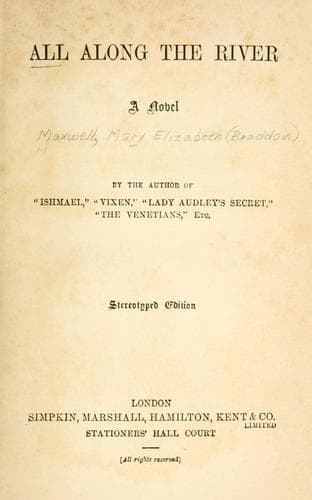
All along the River: A NovelBraddon, M. E. (Mary Elizabeth)
General
All along the River: A Novel
Braddon, M. E. (Mary Elizabeth)
English fiction -- 19th century
Colonel Disney heard all this village gossip with an unheeding ear.
He was secure in his own position as a son of the soil, a man whose
pedigree could pass muster with that of the Rashleighs and the
Treffrys, a man of means that were ample for his own unpretending
tastes and requirements. He cared not a jot how many guineas a year the
Crowthers might give to their cook, or how much Mr. Crowther had paid
for the furnishing and decoration of his house, a theme upon which the
gossips of the neighbourhood loved to enlarge. That Mrs. Crowther had
gowns from Worth, and that her daughters employed Mrs. Mason, irked
not this simple soldier. The only point in all the stream of talk that
had affected him was the unanimous opinion that Trelasco in the spring
had been too relaxing for Mrs. Disney, or else that her solitude had
preyed upon her mind, inasmuch as she had looked so ill as to afford an
interesting subject of conversation to a good many friendly people who
suffered from the chronic malady of not having enough to talk about, a
form of starvation almost as bad as not having enough to eat.
The colonel listened, and made his own conclusions. He did not believe
that Trelasco was “relaxing.” Ho loved the district too well to believe
any evil thing about it. Those fresh breezes that blew up from the sea,
those balmy airs that breathed across the heather-clad hills, must
bring health with them. What could one have better than that mingling
of sea and hill, brine and honey, gorse-bloom and seaweed? No, Trelasco
was not to blame. His young wife had suffered for lack of youthful
company. He made up his mind accordingly.
“I suppose you won’t object to our having Allegra here for a summer
visit, will you, love?” he asked at breakfast the day after Mrs.
Baynham’s call. “London must be hot, and dusty, and dreary in July, and
she must want rest and country air, I fancy, after having worked so
hard in her art school.”
Isola gave a scarcely perceptible sigh as she bent to caress Tim, a
privileged attendant of the breakfast-table.
“Object! Of course not, Martin. I shall be very pleased for your sister
to come here.”
“I feel very sure you will be pleased with her when you and she get
upon intimate terms. You could know so little of her from that one
evening in the Cavendish Road.”
The occasion in question was an evening in which Isola and her husband
had been bidden to a friendly dinner, on their way through London, by
the clergyman’s widow with whom Allegra lived while she pursued her
study of art at a famous school in St. John’s Wood. The clergyman’s
widow, Mrs. Meynell, was a distant cousin of the Disneys, and Allegra’s
home had been with her from the time she left school. The extent of her
wanderings after she was old enough to be sent to a boarding-school had
been from Falmouth to Kensington, and from Kensington to St. John’s
Wood, with occasional holidays in the Isle of Thanet.
Public-domain text, read in full here on John Shaqi.
Reviews
Reviews
No reviews yet
Be the first to share your thoughts on this work.
Elsewhere in the archive
Join the Discussion
Join the discussion
Sign in to leave a comment or review.
Sign InorCreate an account