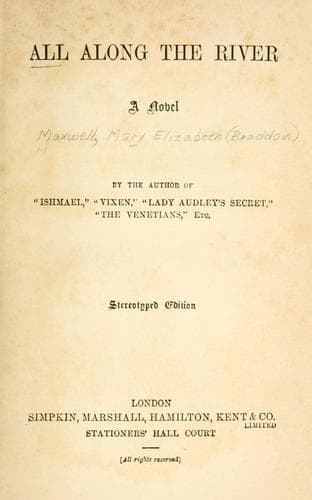
All along the River: A NovelBraddon, M. E. (Mary Elizabeth)
General
All along the River: A Novel
Braddon, M. E. (Mary Elizabeth)
English fiction -- 19th century
The colonel did not thank him for this compliment, which was pronounced
in a loud voice, amidst the little knot of acquaintances taking leave
of each other on the dip of the hill, where there was a sign-post on a
patch of waste grass, and where road and lanes divided, one up the hill
to Tywardreath, another to Fowey, and a narrow-wooded lane leading down
to Glenaveril and the Angler’s Nest. Short as the distance was, there
were carriages waiting for the Crowthers, who never walked to church,
however fine the weather. Mrs. Crowther came to the morning service
resplendent in a brocade gown and a Parisian bonnet, on pain of being
condemned as dowdy by her husband, who liked to put the stamp of his
wealth upon every detail. His wife obeyed him with wifely meekness, but
the daughters were not so easily ruled. Both were keen-witted enough to
feel the vulgarity of Sunday morning splendour. So Belinda worshipped
in the exaggerated simplicity of an unstarched jaconet muslin, a yellow
Liberty sash, a flopping Gainsborough hat, and a necklace of Indian
beads, an attire which attracted every eye, and was a source of wonder
to the whole congregation, while Alicia’s neat grey cashmere frock,
and smart little toque to match, grey gloves, grey Prayer-book and
sunshade, challenged criticism as a study in monochrome.
Mr. Crowther would have lingered for farther conversation before
getting into the family landau, but Colonel Disney bade a rather abrupt
good morning to the whole group, and hurried his wife and sister down
the hill.
“I’m rather sorry we accepted the Glenaveril invitation,” he said to
Isola. “The man is such an unmitigated cad.”
“Mrs. Crowther is very kind and good,” replied his wife; “but I have
never cared much about going to Glenaveril. I don’t feel that I get on
particularly well with the girls. They are both too fine for me. But I
should be sorry to offend Mrs. Crowther.”
“Yes, she seems a kindly creature. It was thoughtful of her sending you
a ticket for the ball. A woman with daughters is seldom over-kind to
outsiders.”
“Oh, I believe Mrs. Crowther’s heart is big enough to be kind to a
whole parish.”
“Well, on her account, perhaps it was best to accept the invitation.”
“Don’t be so grand about it, Martin,” said Allegra. “You forget that
I am pining to see what a dinner-party in a very rich house is like.
I have seen nothing in London but literary and artistic dinners,
third-rate literary and third-rate artistic, I’m afraid--but they were
very nice, all the same. Glenaveril is a place that takes my breath
away; and I am curious to see what a dinner-party can be like there.”
“Then for your sake, Allegra, I’m glad we said yes. Only I couldn’t
stand that fellow patronizing you. Calling you a fine girl, forsooth!”
“Yes, it is an odious phrase, is it not? I’m afraid I shall have to
live through it, because, like Rosalind, ‘I am more than common tall.’”
Public-domain text, read in full here on John Shaqi.
Reviews
Reviews
No reviews yet
Be the first to share your thoughts on this work.
Elsewhere in the archive
Join the Discussion
Join the discussion
Sign in to leave a comment or review.
Sign InorCreate an account