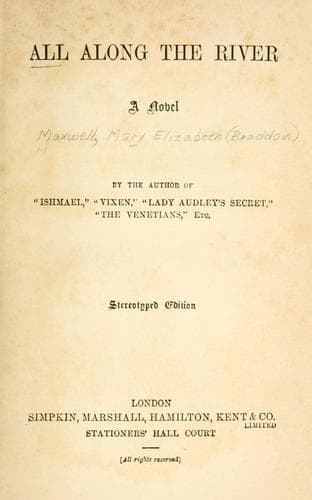
All along the River: A NovelBraddon, M. E. (Mary Elizabeth)
General
All along the River: A Novel
Braddon, M. E. (Mary Elizabeth)
English fiction -- 19th century
Mr. Colfox deserted the young ladies, still puzzling over the two
bits of iron, and went across the room to greet the Disneys. He was
an intelligent young man, steeped to the lips in the opinions and the
prejudices of university life--Oxford life, that is to say. He ranked
as a literary man in Trelasco, on the strength of having had an article
almost published in Blackwood. “The editor had accepted my paper,” he
told people modestly; “but on further consideration he found it was a
little too long, and so, in point of fact, he sent it back to me in the
most courteous manner. He couldn’t have acted more kindly--but I was
disappointed. It would have been such an opening, you see.”
All Mr. Colfox’s friends agreed that with such an opening the high road
to literary fame and fortune would have been made smooth for his feet.
They respected him even for this disappointment. To have been accepted
by Blackwood made him almost a colleague of George Eliot.
He was a tall and rather lean young man, who wore an eye-glass, and
seemed to live upon books. It was irritating to Vansittart Crowther,
who prided himself on his cellar and his cook, to note how little
impression food and drink made upon Francis Colfox.
“He takes my Château Yquem as if it were Devonshire cider,” said the
aggrieved parvenu, “and he hardly seems to know that this is the only
house where he ever sees clear turtle. The man’s people must have lived
in a very poor way.”
In spite of this contemptuous opinion, Mr. Crowther was always polite
to Francis Colfox, and had even thought of him as a _pis-aller_ for
one of his daughters. There is hardly anything in this life which a
self-made man respects so much as race, and Francis Colfox belonged to
an old county family, had a cousin who was an earl, and another cousin
who was talked of as a probable bishop. He was, therefore, allowed to
make himself very much at home at Glenaveril, and to speak his mind in
a somewhat audacious way to the whole family.
Captain Pentreath, an army man of uncertain age, a bachelor, and one
of a territorial family of many brothers, came next; and then appeared
the vicar and his wife and one daughter, who made up the party. The
vicar was deaf, but amiable, and beamed benevolently upon a world about
whose spoken opinions he knew so little that he might naturally have
taken it for a much better world than it is. The vicar’s wife spent her
existence in interpreting and explaining people’s speech to the vicar,
and had no time to spare for opinions of her own. The daughter was
characterized by a gentle nullity, tempered by a somewhat enthusiastic
and evangelical piety. The chief desire of her life was to keep the
Church as it had been in the days of her childhood, nearly thirty years
before.
Public-domain text, read in full here on John Shaqi.
Reviews
Reviews
No reviews yet
Be the first to share your thoughts on this work.
Elsewhere in the archive
Join the Discussion
Join the discussion
Sign in to leave a comment or review.
Sign InorCreate an account