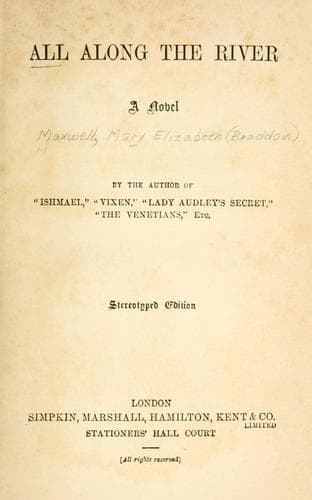
All along the River: A NovelBraddon, M. E. (Mary Elizabeth)
General
All along the River: A Novel
Braddon, M. E. (Mary Elizabeth)
English fiction -- 19th century
Isola had felt both embarrassed and distressed by her host’s
attentions--the insinuating inflections of his fat, pompous voice; his
air of being upon a confidential footing with her. It had seemed to
her on that evening as if for the first time in her life, before the
eyes of men and women, she drank the cup of shame. She had said no word
to her husband of Mr. Crowther’s oppressive familiarity, and she had
fondly hoped that the matter had escaped his notice.
She sat before him now, flushed and agitated, with lowered eyelids, and
one hand restlessly moving about the papers on her blotting-pad.
“My dearest, there is nothing in all this to distress you,” said
Disney, with infinite gentleness. “It is not your fault that the man is
a cad; but it would be my fault if I were to allow you or Allegra to go
to his house again.”
“He was not rude to Allegra.”
“No; it would be her turn next, perhaps. He did not mean to be rude to
you. He only wanted to be especially polite in his own odious fashion.
There are men in that class who cannot behave decently to a pretty
woman, or civilly to a plain one. He meant no doubt to gratify you by
his compliments. What a stress he laid upon Lostwithiel’s attention to
you at the ball. Were his attentions so very marked?”
“Oh no; not more to me than to others,” Isola answered quickly. “He
danced a good many times--twice or three times--with Belinda Crowther.
Everybody noticed them as the handsomest couple in the room; not that
he is handsome, of course--only tall and distinguished-looking.”
Allegra came running in from the garden, and broke the thread of
the conversation. Isola put the visiting-cards into an envelope and
addressed it to Mrs. Vansittart Crowther. She felt that the kindly
matron would be puzzled and vexed at this ceremony, from a young person
towards whom she had assumed so motherly a tone, urging her to run over
to Glenaveril at any hour of the day--asking her to lunch or to tea at
least once a week--wanting to take her for drives to Lostwithiel, or
railway jaunts to Plymouth.
Isola was not mistaken, for Mrs. Crowther called three or four days
afterwards and upbraided her for sending the cards.
“You might have all come to tea on Thursday, if you had been
good-natured,” she said. “Mr. Colfox read us a poem by Swinburne, out
of one of the new magazines--there are so many nowadays that I never
remember which is which. Belinda was delighted with it--but Alicia and
I can’t rise to her height. Mr. Colfox reads poetry beautifully. You
can’t judge of his powers by only hearing him read the lessons,” added
Mrs. Crowther, as if the English Bible were a poor thing.
She stopped an hour, praised Isola’s tea-making and the new cook’s
tea-cakes, asked a great many questions about Allegra’s ideas and
occupations, and was as hearty, and simple, and friendly, and natural
as if she had been a duchess.
It grieved Isola to be obliged to refuse an invitation to luncheon,
most cordially pressed upon her and Allegra.
Public-domain text, read in full here on John Shaqi.
Reviews
Reviews
No reviews yet
Be the first to share your thoughts on this work.
Elsewhere in the archive
Join the Discussion
Join the discussion
Sign in to leave a comment or review.
Sign InorCreate an account