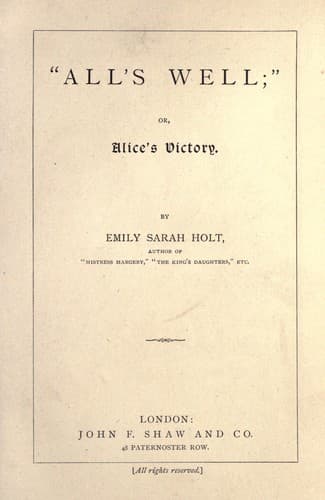
"All's Well"; or, Alice's VictoryHolt, Emily Sarah
General
"All's Well"; or, Alice's Victory
Holt, Emily Sarah
Counter-Reformation -- England -- Fiction; Historical fiction
"Ay, 'tis strange, in very deed, they cannot let be this foolish
meddling with matters too high for them. If the woman would but conform
and go to church, I hear, her womanish fantasies should very like be
overlooked. Good lack I can a man not believe as he list, yet hold his
tongue and be quiet, and not bring down the laws on his head?" concluded
the Justice somewhat testily.
There was a pause, during which all were silent--from very various
motives. Mr Roberts was thinking rather sadly that the only choice
offered to men in those days was a choice of evils. He had never wished
to conform--never would have done so, had he been let alone: but a man
must look out for his safety, and take care of his property--of course
he must!--and if the authorities made it impossible for him to do so
with a good conscience, why, the fault was theirs, not his. Thus argued
Mr Roberts, forgetting that the man makes a poor bargain who gains the
whole world and loses himself. The Justice and Gertrude were simply
enjoying their supper. No scruples of any kind disturbed their
slumbering consciences. Mistress Collenwood's face gave no indication
of her thoughts. Pandora was reflecting chiefly upon Christabel.
But there was one present whose conscience had been asleep, and was just
waking to painful life. For nearly four years had Grena Holland soothed
her many misgivings by some such reasoning as that of Mr Justice
Roberts. She had conformed outwardly: had not merely abstained from
contradictory speeches, but had gone to mass, had attended the
confessional, had bowed down before images of wood and stone, and all
the time had comforted herself by imagining that God saw her heart, and
knew that she did not really believe in any of these things, but only
acted thus for safety's sake. Now, all at once, she knew not how, it
came on her as by a flash of lightning that she was on the road that
leadeth to destruction, and not content with that, was bearing her young
nieces along with her. She loved those girls as if she had been their
own mother. Grave, self-contained, and undemonstrative as she was, she
would almost have given her life for either, but especially for Pandora,
who in face, and to some extent in character, resembled her dead mother,
the sister who had been the darling of Grena Holland's heart. She
recalled with keen pain the half-astonished, half-shrinking look on
Pandora's face, as she had followed her to mass on the first holy-day
after her return from Lancashire. Grena knew well that at Shardeford
Hall, her mother's house in Lancashire, Pandora would never have been
required to attend mass, but would have been taught that it was "a fond
fable and a dangerous deceit." And now, she considered, that look had
passed from the girl's face; she went silently, not eagerly on the one
hand, yet unprotestingly, even by look, on the other. Forward into the
possible future went Grena's imagination--to the prison, and the
Public-domain text, read in full here on John Shaqi.
Reviews
Reviews
No reviews yet
Be the first to share your thoughts on this work.
Elsewhere in the archive
Join the Discussion
Join the discussion
Sign in to leave a comment or review.
Sign InorCreate an account