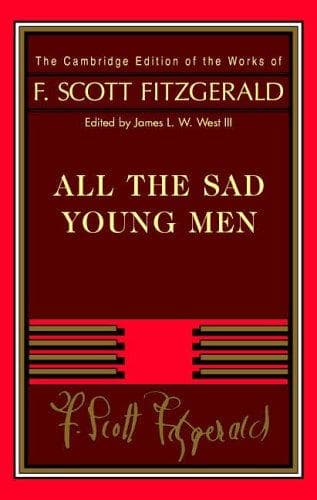
All the Sad Young MenFitzgerald, F. Scott (Francis Scott)
General
All the Sad Young Men
Fitzgerald, F. Scott (Francis Scott)
American fiction -- 20th century; Short stories, American
Mather had come out of his abstraction now, and the monosyllable held an
undisguised quality of shock. Then his natural tact acted automatically,
springing to his aid and dictating his words though his brain was
suddenly numb. His immediate instinct was to put Drake at ease in his
refusal.
"Oh, I see." He nodded his head as if in full agreement, as if he
himself had often considered adopting just such a rule. "Oh, I see how
you feel. Well--I just--I wouldn't have you break a rule like that for
anything. It's probably a good thing."
They talked for a minute longer. Drake justified his position easily; he
had evidently rehearsed the part a great deal. He treated Mather to an
exquisitely frank smile.
Mather went politely back to his office leaving Drake under the
impression that the latter was the most tactful man in the city. Mather
knew how to leave people with that impression. But when he entered his
own office and saw his wife staring dismally out the window into the
sunshine he clinched his hands, and his mouth moved in an unfamiliar
shape.
"All right, Jack," he said slowly, "I guess you're right about most
things, and I'm wrong as hell."
III
During the next three months Mather thought back through many years. He
had had an unusually happy life. Those frictions between man and man,
between man and society, which harden most of us into a rough and
cynical quarrelling trim, had been conspicuous by their infrequency in
his life. It had never occurred to him before that he had paid a price
for this immunity, but now he perceived how here and there, and
constantly, he had taken the rough side of the road to avoid enmity or
argument, or even question.
There was, for instance, much money that he had lent privately, about
thirteen hundred dollars in all, which he realized, in his new
enlightenment, he would never see again. It had taken Jaqueline's
harder, feminine intelligence to know this. It was only now when he owed
it to Jaqueline to have money in the bank that he missed these loans at
all.
He realized too the truth of her assertions that he was continually
doing favors--a little something here, a little something there; the sum
total, in time and energy expended, was appalling. It had pleased him to
do the favors. He reacted warmly to being thought well of, but he
wondered now if he had not been merely indulging a selfish vanity of his
own. In suspecting this, he was, as usual, not quite fair to himself.
The truth was that Mather was essentially and enormously romantic.
He decided that these expenditures of himself made him tired at night,
less efficient in his work, and less of a prop to Jaqueline, who, as the
months passed, grew more heavy and bored, and sat through the long
summer afternoons on the screened veranda waiting for his step at the
end of the walk.
Public-domain text, read in full here on John Shaqi.
Reviews
Reviews
No reviews yet
Be the first to share your thoughts on this work.
Elsewhere in the archive
Join the Discussion
Join the discussion
Sign in to leave a comment or review.
Sign InorCreate an account