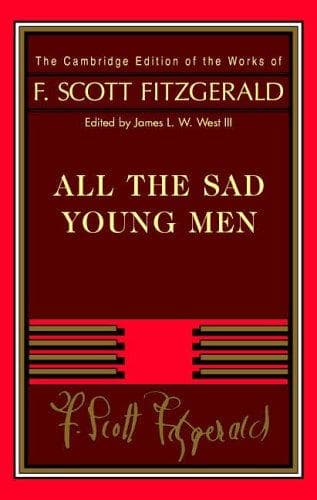
All the Sad Young MenFitzgerald, F. Scott (Francis Scott)
General
All the Sad Young Men
Fitzgerald, F. Scott (Francis Scott)
American fiction -- 20th century; Short stories, American
At the Great American Lunch Hour young George O'Kelly straightened his
desk deliberately and with an assumed air of interest. No one in the
office must know that he was in a hurry, for success is a matter of
atmosphere, and it is not well to advertise the fact that your mind is
separated from your work by a distance of seven hundred miles.
But once out of the building he set his teeth and began to run, glancing
now and then at the gay noon of early spring which filled Times Square
and loitered less than twenty feet over the heads of the crowd. The
crowd all looked slightly upward and took deep March breaths, and the
sun dazzled their eyes so that scarcely any one saw any one else but
only their own reflection on the sky.
George O'Kelly, whose mind was over seven hundred miles away, thought
that all outdoors was horrible. He rushed into the subway, and for
ninety-five blocks bent a frenzied glance on a car-card which showed
vividly how he had only one chance in five of keeping his teeth for ten
years. At 137th Street he broke off his study of commercial art, left
the subway, and began to run again, a tireless, anxious run that brought
him this time to his home--one room in a high, horrible apartment-house
in the middle of nowhere.
There it was on the bureau, the letter--in sacred ink, on blessed
paper--all over the city, people, if they listened, could hear the
beating of George O'Kelly's heart. He read the commas, the blots, and the
thumb-smudge on the margin--then he threw himself hopelessly upon his
bed.
He was in a mess, one of those terrific messes which are ordinary
incidents in the life of the poor, which follow poverty like birds of
prey. The poor go under or go up or go wrong or even go on, somehow, in
a way the poor have--but George O'Kelly was so new to poverty that had
any one denied the uniqueness of his case he would have been astounded.
Less than two years ago he had been graduated with honors from The
Massachusetts Institute of Technology and had taken a position with a
firm of construction engineers in southern Tennessee. All his life he
had thought in terms of tunnels and skyscrapers and great squat dams and
tall, three-towered bridges, that were like dancers holding hands in a
row, with heads as tall as cities and skirts of cable strand. It had
seemed romantic to George O'Kelly to change the sweep of rivers and the
shape of mountains so that life could flourish in the old bad lands of
the world where it had never taken root before. He loved steel, and
there was always steel near him in his dreams, liquid steel, steel in
bars, and blocks and beams and formless plastic masses, waiting for him,
as paint and canvas to his hand. Steel inexhaustible, to be made lovely
and austere in his imaginative fire ...
Public-domain text, read in full here on John Shaqi.
Reviews
Reviews
No reviews yet
Be the first to share your thoughts on this work.
Elsewhere in the archive
Join the Discussion
Join the discussion
Sign in to leave a comment or review.
Sign InorCreate an account