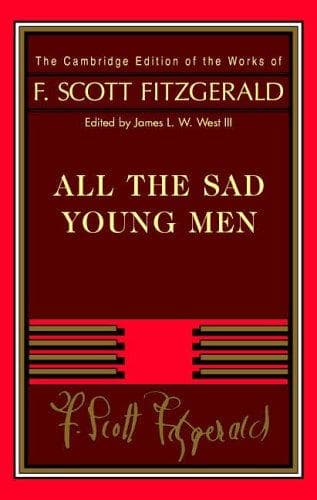
All the Sad Young MenFitzgerald, F. Scott (Francis Scott)
General
All the Sad Young Men
Fitzgerald, F. Scott (Francis Scott)
American fiction -- 20th century; Short stories, American
His wife, a bright-colored, Titian-haired girl, vivid as a French rag
doll, followed him into the living-room.
"Listen, Gretchen"--he sat down at the end of the sofa--"beginning with
to-night I'm going to--What's the matter?"
"Nothing. I'm just looking for a cigarette. Go on."
She tiptoed breathlessly back to the sofa and settled at the other end.
"Gretchen--" Again he broke off. Her hand, palm upward, was extended
toward him. "Well, what is it?" he asked wildly.
"Matches."
"What?"
In his impatience it seemed incredible that she should ask for matches,
but he fumbled automatically in his pocket.
"Thank you," she whispered. "I didn't mean to interrupt you. Go on."
"Gretch----"
Scratch! The match flared. They exchanged a tense look.
Her fawn's eyes apologized mutely this time, and he laughed. After all,
she had done no more than light a cigarette; but when he was in this
mood her slightest positive action irritated him beyond measure.
"When you've got time to listen," he said crossly, "you might be
interested in discussing the poorhouse question with me."
"What poorhouse?" Her eyes were wide, startled; she sat quiet as a
mouse.
"That was just to get your attention. But, beginning to-night, I start
on what'll probably be the most important six weeks of my life--the six
weeks that'll decide whether we're going on forever in this rotten
little house in this rotten little suburban town."
Boredom replaced alarm in Gretchen's black eyes. She was a Southern
girl, and any question that had to do with getting ahead in the world
always tended to give her a headache.
"Six months ago I left the New York Lithographic Company," announced
Roger, "and went in the advertising business for myself."
"I know," interrupted Gretchen resentfully; "and now instead of getting
six hundred a month sure, we're living on a risky five hundred."
"Gretchen," said Roger sharply, "if you'll just believe in me as hard as
you can for six weeks more we'll be rich. I've got a chance now to get
some of the biggest accounts in the country." He hesitated. "And for
these six weeks we won't go out at all, and we won't have any one here.
I'm going to bring home work every night, and we'll pull down all the
blinds and if any one rings the door-bell we won't answer."
He smiled airily as if it were a new game they were going to play. Then,
as Gretchen was silent, his smile faded, and he looked at her
uncertainly.
"Well, what's the matter?" she broke out finally. "Do you expect me to
jump up and sing? You do enough work as it is. If you try to do any more
you'll end up with a nervous breakdown. I read about a----"
"Don't worry about me," he interrupted; "I'm all right. But you're going
to be bored to death sitting here every evening."
"No, I won't," she said without conviction--"except to-night."
"What about to-night?"
"George Tompkins asked us to dinner."
"Did you accept?"
Public-domain text, read in full here on John Shaqi.
Reviews
Reviews
No reviews yet
Be the first to share your thoughts on this work.
Elsewhere in the archive
Join the Discussion
Join the discussion
Sign in to leave a comment or review.
Sign InorCreate an account