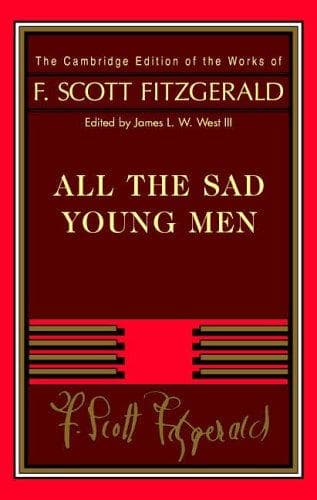
All the Sad Young MenFitzgerald, F. Scott (Francis Scott)
General
All the Sad Young Men
Fitzgerald, F. Scott (Francis Scott)
American fiction -- 20th century; Short stories, American
He had thought that having nothing else to lose he was invulnerable at
last--but he knew that he had just lost something more, as surely as if
he had married Judy Jones and seen her fade away before his eyes.
The dream was gone. Something had been taken from him. In a sort of
panic he pushed the palms of his hands into his eyes and tried to bring
up a picture of the waters lapping on Sherry Island and the moonlit
veranda, and gingham on the golf-links and the dry sun and the gold
color of her neck's soft down. And her mouth damp to his kisses and her
eyes plaintive with melancholy and her freshness like new fine linen in
the morning. Why, these things were no longer in the world! They had
existed and they existed no longer.
For the first time in years the tears were streaming down his face. But
they were for himself now. He did not care about mouth and eyes and
moving hands. He wanted to care, and he could not care. For he had gone
away and he could never go back any more. The gates were closed, the sun
was gone down, and there was no beauty but the gray beauty of steel that
withstands all time. Even the grief he could have borne was left behind
in the country of illusion, of youth, of the richness of life, where his
winter dreams had flourished.
"Long ago," he said, "long ago, there was something in me, but now that
thing is gone. Now that thing is gone, that thing is gone. I cannot cry.
I cannot care. That thing will come back no more."
THE BABY PARTY
When John Andros felt old he found solace in the thought of life
continuing through his child. The dark trumpets of oblivion were less
loud at the patter of his child's feet or at the sound of his child's
voice babbling mad non sequiturs to him over the telephone. The latter
incident occurred every afternoon at three when his wife called the
office from the country, and he came to look forward to it as one of the
vivid minutes of his day.
He was not physically old, but his life had been a series of struggles
up a series of rugged hills, and here at thirty-eight having won his
battles against ill-health and poverty he cherished less than the usual
number of illusions. Even his feeling about his little girl was
qualified. She had interrupted his rather intense love-affair with his
wife, and she was the reason for their living in a suburban town, where
they paid for country air with endless servant troubles and the weary
merry-go-round of the commuting train.
Public-domain text, read in full here on John Shaqi.
Reviews
Reviews
No reviews yet
Be the first to share your thoughts on this work.
Join the Discussion
Join the discussion
Sign in to leave a comment or review.
Sign InorCreate an account