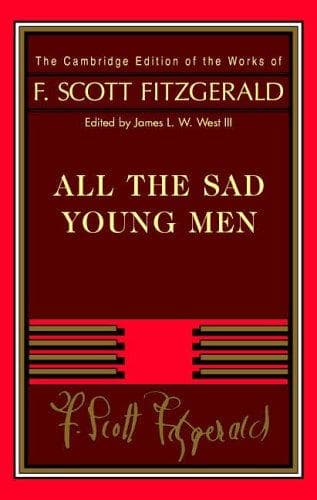
All the Sad Young MenFitzgerald, F. Scott (Francis Scott)
General
All the Sad Young Men
Fitzgerald, F. Scott (Francis Scott)
American fiction -- 20th century; Short stories, American
It was little Ede as a definite piece of youth that chiefly interested
him. He liked to take her on his lap and examine minutely her fragrant,
downy scalp and her eyes with their irises of morning blue. Having paid
this homage John was content that the nurse should take her away. After
ten minutes the very vitality of the child irritated him; he was
inclined to lose his temper when things were broken, and one Sunday
afternoon when she had disrupted a bridge game by permanently hiding up
the ace of spades, he had made a scene that had reduced his wife to
tears.
This was absurd and John was ashamed of himself. It was inevitable that
such things would happen, and it was impossible that little Ede should
spend all her indoor hours in the nursery up-stairs when she was
becoming, as her mother said, more nearly a "real person" every day.
She was two and a half, and this afternoon, for instance, she was going
to a baby party. Grown-up Edith, her mother, had telephoned the
information to the office, and little Ede had confirmed the business by
shouting "I yam going to a _pantry_!" into John's unsuspecting left ear.
"Drop in at the Markeys' when you get home, won't you, dear?" resumed
her mother. "It'll be funny. Ede's going to be all dressed up in her new
pink dress----"
The conversation terminated abruptly with a squawk which indicated that
the telephone had been pulled violently to the floor. John laughed and
decided to get an early train out; the prospect of a baby party in some
one else's house amused him.
"What a peach of a mess!" he thought humorously. "A dozen mothers, and
each one looking at nothing but her own child. All the babies breaking
things and grabbing at the cake, and each mama going home thinking about
the subtle superiority of her own child to every other child there."
He was in a good humor to-day--all the things in his life were going
better than they had ever gone before. When he got off the train at his
station he shook his head at an importunate taxi man, and began to walk
up the long hill toward his house through the crisp December twilight.
It was only six o'clock but the moon was out, shining with proud
brilliance on the thin sugary snow that lay over the lawns.
As he walked along drawing his lungs full of cold air his happiness
increased, and the idea of a baby party appealed to him more and more.
He began to wonder how Ede compared to other children of her own age,
and if the pink dress she was to wear was something radical and mature.
Increasing his gait he came in sight of his own house, where the lights
of a defunct Christmas-tree still blossomed in the window, but he
continued on past the walk. The party was at the Markeys' next door.
Public-domain text, read in full here on John Shaqi.
Reviews
Reviews
No reviews yet
Be the first to share your thoughts on this work.
Join the Discussion
Join the discussion
Sign in to leave a comment or review.
Sign InorCreate an account