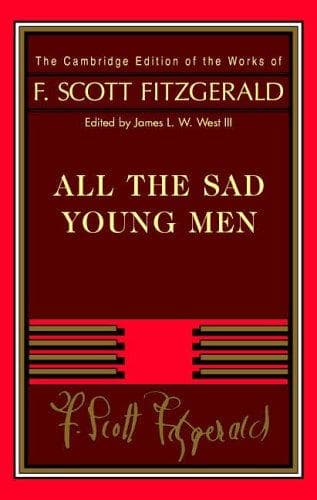
All the Sad Young MenFitzgerald, F. Scott (Francis Scott)
General
All the Sad Young Men
Fitzgerald, F. Scott (Francis Scott)
American fiction -- 20th century; Short stories, American
As he mounted the brick step and rang the bell he became aware of voices
inside, and he was glad he was not too late. Then he raised his head and
listened--the voices were not children's voices, but they were loud and
pitched high with anger; there were at least three of them and one,
which rose as he listened to a hysterical sob, he recognized immediately
as his wife's.
"There's been some trouble," he thought quickly.
Trying the door, he found it unlocked and pushed it open.
The baby party began at half past four, but Edith Andros, calculating
shrewdly that the new dress would stand out more sensationally against
vestments already rumpled, planned the arrival of herself and little Ede
for five. When they appeared it was already a flourishing affair. Four
baby girls and nine baby boys, each one curled and washed and dressed
with all the care of a proud and jealous heart, were dancing to the
music of a phonograph. Never more than two or three were dancing at
once, but as all were continually in motion running to and from their
mothers for encouragement, the general effect was the same.
As Edith and her daughter entered, the music was temporarily drowned out
by a sustained chorus, consisting largely of the word _cute_ and directed
toward little Ede, who stood looking timidly about and fingering the
edges of her pink dress. She was not kissed--this is the sanitary
age--but she was passed along a row of mamas each one of whom said
"cu-u-ute" to her and held her pink little hand before passing her on to
the next. After some encouragement and a few mild pushes she was
absorbed into the dance, and became an active member of the party.
Edith stood near the door talking to Mrs. Markey, and keeping one eye on
the tiny figure in the pink dress. She did not care for Mrs. Markey; she
considered her both snippy and common, but John and Joe Markey were
congenial and went in together on the commuting train every morning, so
the two women kept up an elaborate pretense of warm amity. They were
always reproaching each other for "not coming to see me," and they were
always planning the kind of parties that began with "You'll have to come
to dinner with us soon, and we'll go in to the theatre," but never
matured further.
"Little Ede looks perfectly darling," said Mrs. Markey, smiling and
moistening her lips in a way that Edith found particularly repulsive.
"So _grown-up_--I can't _believe_ it!"
Edith wondered if "little Ede" referred to the fact that Billy Markey,
though several months younger, weighed almost five pounds more.
Accepting a cup of tea she took a seat with two other ladies on a divan
and launched into the real business of the afternoon, which of course
lay in relating the recent accomplishments and insouciances of her
child.
Public-domain text, read in full here on John Shaqi.
Reviews
Reviews
No reviews yet
Be the first to share your thoughts on this work.
Join the Discussion
Join the discussion
Sign in to leave a comment or review.
Sign InorCreate an account