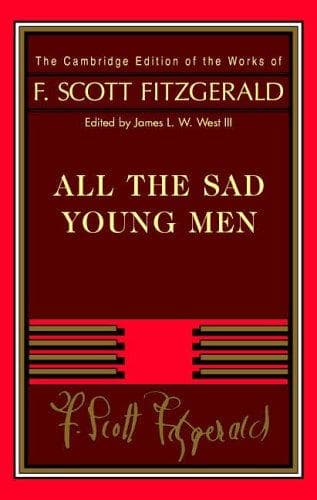
All the Sad Young MenFitzgerald, F. Scott (Francis Scott)
General
All the Sad Young Men
Fitzgerald, F. Scott (Francis Scott)
American fiction -- 20th century; Short stories, American
Rudolph had now exhausted the minor offenses, and was approaching the
sins it was agony to tell. He held his fingers against his face like
bars as if to press out between them the shame in his heart.
"Of dirty words and immodest thoughts and desires," he whispered very
low.
"How often?"
"I don't know."
"Once a week? Twice a week?"
"Twice a week."
"Did you yield to these desires?"
"No, Father."
"Were you alone when you had them?"
"No, Father. I was with two boys and a girl."
"Don't you know, my child, that you should avoid the occasions of sin as
well as the sin itself? Evil companionship leads to evil desires and
evil desires to evil actions. Where were you when this happened?"
"In a barn in back of----"
"I don't want to hear any names," interrupted the priest sharply.
"Well, it was up in the loft of this barn and this girl and--a fella,
they were saying things--saying immodest things, and I stayed."
"You should have gone--you should have told the girl to go."
He should have gone! He could not tell Father Schwartz how his pulse had
bumped in his wrist, how a strange, romantic excitement had possessed
him when those curious things had been said. Perhaps in the houses of
delinquency among the dull and hard-eyed incorrigible girls can be found
those for whom has burned the whitest fire.
"Have you anything else to tell me?"
"I don't think so, Father."
Rudolph felt a great relief. Perspiration had broken out under his
tight-pressed fingers.
"Have you told any lies?"
The question startled him. Like all those who habitually and
instinctively lie, he had an enormous respect and awe for the truth.
Something almost exterior to himself dictated a quick, hurt answer.
"Oh, no, Father, I never tell lies."
For a moment, like the commoner in the king's chair, he tasted the pride
of the situation. Then as the priest began to murmur conventional
admonitions he realized that in heroically denying he had told lies, he
had committed a terrible sin--he had told a lie in confession.
In automatic response to Father Schwartz's "Make an act of contrition,"
he began to repeat aloud meaninglessly:
"Oh, my God, I am heartily sorry for having offended Thee...."
He must fix this now--it was a bad mistake--but as his teeth shut on the
last words of his prayer there was a sharp sound, and the slat was
closed.
A minute later when he emerged into the twilight the relief in coming
from the muggy church into an open world of wheat and sky postponed the
full realization of what he had done. Instead of worrying he took a deep
breath of the crisp air and began to say over and over to himself the
words "Blatchford Sarnemington, Blatchford Sarnemington!"
Public-domain text, read in full here on John Shaqi.
Reviews
Reviews
No reviews yet
Be the first to share your thoughts on this work.
Elsewhere in the archive
Join the Discussion
Join the discussion
Sign in to leave a comment or review.
Sign InorCreate an account