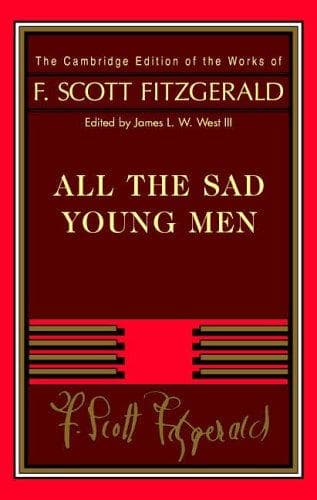
All the Sad Young MenFitzgerald, F. Scott (Francis Scott)
General
All the Sad Young Men
Fitzgerald, F. Scott (Francis Scott)
American fiction -- 20th century; Short stories, American
Tap! Her one hundred and five pounds reached the pier and it seemed to
sway and bend from the shock of her beauty. A few porters fainted. A
large, sentimental shark which had followed the ship across made a
despairing leap to see her once more, and then dove, broken-hearted,
back into the deep sea. Rags Martin-Jones had come home.
There was no member of her family there to meet her, for the simple
reason that she was the only member of her family left alive. In 1913
her parents had gone down on the _Titanic_ together rather than be
separated in this world, and so the Martin-Jones fortune of seventy-five
millions had been inherited by a very little girl on her tenth birthday.
It was what the consumer always refers to as a "shame."
Rags Martin-Jones (everybody had forgotten her real name long ago) was
now photographed from all sides. The monocle persistently fell out, and
she kept laughing and yawning and replacing it, so no very clear picture
of her was taken--except by the motion-picture camera. All the
photographs, however, included a flustered, handsome young man, with an
almost ferocious love-light burning in his eyes, who had met her on
the dock. His name was John M. Chestnut, he had already written the
story of his success for the _American Magazine_, and he had been
hopelessly in love with Rags ever since the time when she, like the
tides, had come under the influence of the summer moon.
When Rags became really aware of his presence they were walking down the
pier, and she looked at him blankly as though she had never seen him
before in this world.
"Rags," he began, "Rags----"
"John M. Chestnut?" she inquired, inspecting him with great interest.
"Of course!" he exclaimed angrily. "Are you trying to pretend you don't
know me? That you didn't write me to meet you here?"
She laughed. A chauffeur appeared at her elbow, and she twisted out of
her coat, revealing a dress made in great splashy checks of sea-blue and
gray. She shook herself like a wet bird.
"I've got a lot of junk to declare," she remarked absently.
"So have I," said Chestnut anxiously, "and the first thing I want to
declare is that I've loved you, Rags, every minute since you've been
away."
She stopped him with a groan.
"Please! There were some young Americans on the boat. The subject has
become a bore."
"My God!" cried Chestnut, "do you mean to say that you class _my_ love
with what was said to you on a _boat_?"
His voice had risen, and several people in the vicinity turned to hear.
"Sh!" she warned him, "I'm not giving a circus. If you want me to even
see you while I'm here, you'll have to be less violent."
But John M. Chestnut seemed unable to control his voice.
"Do you mean to say"--it trembled to a carrying pitch--"that you've
forgotten what you said on this very pier five years ago last Thursday?"
Half the passengers from the ship were now watching the scene on the
dock, and another little eddy drifted out of the customs-house to see.
Public-domain text, read in full here on John Shaqi.
Reviews
Reviews
No reviews yet
Be the first to share your thoughts on this work.
Elsewhere in the archive
Join the Discussion
Join the discussion
Sign in to leave a comment or review.
Sign InorCreate an account