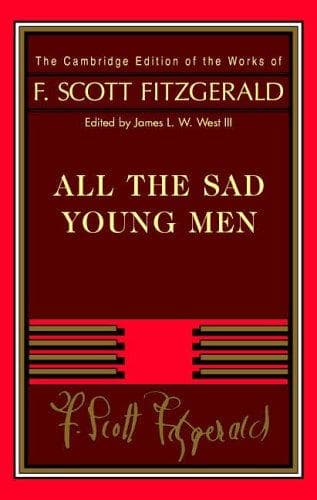
All the Sad Young MenFitzgerald, F. Scott (Francis Scott)
General
All the Sad Young Men
Fitzgerald, F. Scott (Francis Scott)
American fiction -- 20th century; Short stories, American
"The next stop is the City Hall. Then, if you like, we'll run over to
Paris."
"John," she asked him intently, "who was the Prince of Wales?"
He waited till they were in the elevator, dropping twenty floors at a
swoop. Then he leaned forward and tapped the lift-boy on the shoulder.
"Not so fast, Cedric. This lady isn't used to falls from high places."
The elevator-boy turned around, smiled. His face was pale, oval, framed
in yellow hair. Rags blushed like fire.
"Cedric's from Wessex," explained John. "The resemblance is, to say the
least, amazing. Princes are not particularly discreet, and I suspect
Cedric of being a Guelph in some left-handed way."
Rags took the monocle from around her neck and threw the ribbon over
Cedric's head.
"Thank you," she said simply, "for the second greatest thrill of my
life."
John Chestnut began rubbing his hands together in a commercial gesture.
"Patronize this place, lady," he besought her. "Best bazaar in the
city!"
"What have you got for sale?"
"Well, m'selle, to-day we have some perfectly bee-_oo_-tiful love."
"Wrap it up, Mr. Merchant," cried Rags Martin-Jones. "It looks like a
bargain to me."
THE ADJUSTER
At five o'clock the sombre egg-shaped room at the Ritz ripens to a
subtle melody--the light _clat-clat_ of one lump, two lumps, into the
cup, and the _ding_ of the shining teapots and cream-pots as they kiss
elegantly in transit upon a silver tray. There are those who cherish
that amber hour above all other hours, for now the pale, pleasant toil
of the lilies who inhabit the Ritz is over--the singing decorative part
of the day remains.
Moving your eyes around the slightly raised horseshoe balcony you might,
one spring afternoon, have seen young Mrs. Alphonse Karr and young Mrs.
Charles Hemple at a table for two. The one in the dress was Mrs.
Hemple--when I say "the dress" I refer to that black immaculate affair
with the big buttons and the red ghost of a cape at the shoulders, a
gown suggesting with faint and fashionable irreverence the garb of a
French cardinal, as it was meant to do when it was invented in the Rue
de la Paix. Mrs. Karr and Mrs. Hemple were twenty-three years old, and
their enemies said that they had done very well for themselves. Either
might have had her limousine waiting at the hotel door, but both of them
much preferred to walk home (up Park Avenue) through the April twilight.
Luella Hemple was tall, with the sort of flaxen hair that English
country girls should have, but seldom do. Her skin was radiant, and
there was no need of putting anything on it at all, but in deference to
an antiquated fashion--this was the year 1920--she had powdered out its
high roses and drawn on it a new mouth and new eyebrows--which were no
more successful than such meddling deserves. This, of course, is said
from the vantage-point of 1925. In those days the effect she gave was
exactly right.
Public-domain text, read in full here on John Shaqi.
Reviews
Reviews
No reviews yet
Be the first to share your thoughts on this work.
Elsewhere in the archive
Join the Discussion
Join the discussion
Sign in to leave a comment or review.
Sign InorCreate an account