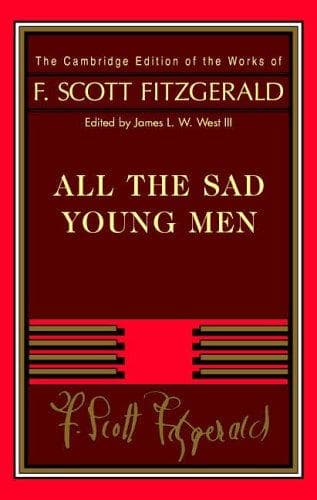
All the Sad Young MenFitzgerald, F. Scott (Francis Scott)
General
All the Sad Young Men
Fitzgerald, F. Scott (Francis Scott)
American fiction -- 20th century; Short stories, American
It infuriated Luella that he claimed to understand. Her feeling of
defiance had reached such a pitch that she preferred that no one should
understand. She was content to be justified by the impassioned sincerity
of her desires.
"I've tried to be good, and I'm not going to try any more. If I'm one of
those women who wreck their lives for nothing, then I'll do it now. You
can call me selfish, or silly, and be quite right; but in five minutes
I'm going out of this house and begin to be alive."
This time Doctor Moon didn't answer, but he raised his head as if he
were listening to something that was taking place a little distance
away.
"You're not going out," he said after a moment; "I'm quite sure you're
not going out."
Luella laughed.
"I _am_ going out."
He disregarded this.
"You see, Mrs. Hemple, your husband isn't well. He's been trying to live
your kind of life, and the strain of it has been too much for him. When
he rubs his mouth----"
Light steps came down the corridor, and the maid, with a frightened
expression on her face, tiptoed into the room.
"Mrs. Hemple----"
Startled at the interruption, Luella turned quickly.
"Yes?"
"Can I speak to--?" Her fear broke precipitately through her slight
training. "Mr. Hemple, he's sick! He came into the kitchen a while ago
and began throwing all the food out of the ice-box, and now he's in his
room, crying and singing----"
Suddenly Luella heard his voice.
III
Charles Hemple had had a nervous collapse. There were twenty years of
almost uninterrupted toil upon his shoulders, and the recent pressure at
home had been too much for him to bear. His attitude toward his wife was
the weak point in what had otherwise been a strong-minded and
well-organized career--he was aware of her intense selfishness, but it
is one of the many flaws in the scheme of human relationships that
selfishness in women has an irresistible appeal to many men. Luella's
selfishness existed side by side with a childish beauty, and, in
consequence, Charles Hemple had begun to take the blame upon himself for
situations which she had obviously brought about. It was an unhealthy
attitude, and his mind had sickened, at length, with his attempts to put
himself in the wrong.
After the first shock and the momentary flush of pity that followed it,
Luella looked at the situation with impatience. She was "a good
sport"--she couldn't take advantage of Charles when he was sick. The
question of her liberties had to be postponed until he was on his feet.
Just when she had determined to be a wife no longer, Luella was
compelled to be a nurse as well. She sat beside his bed while he talked
about her in his delirium--about the days of their engagement, and how
some friend had told him then that he was making a mistake, and about
his happiness in the early months of their marriage, and his growing
disquiet as the gap appeared. Evidently he had been more aware of it
than she had thought--more than he ever said.
Public-domain text, read in full here on John Shaqi.
Reviews
Reviews
No reviews yet
Be the first to share your thoughts on this work.
Elsewhere in the archive
Join the Discussion
Join the discussion
Sign in to leave a comment or review.
Sign InorCreate an account