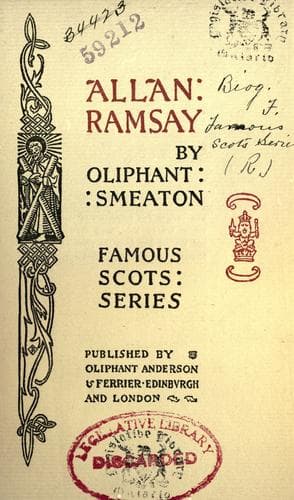
Poets, Scottish -- 18th century -- Biography; Ramsay, Allan, 1686-1758
Catholic times, has often been admired, as almost Chaucerian, for its
force and truth--
'The latter-gae of haly rhime,
Sat up at the boord head,
And a' he said 'twas thought a crime
To contradict indeed.
For in clerk lear he was right prime,
And could baith write and read,
And drank sae firm till ne'er a styme
He could keek on a bead
Or book that day.'
The coarseness of the pieces cannot be denied. Still, withal, there is a
robust, manly strength in the ideas and a picturesque force in the
vocabulary that covers a multitude of sins. His picture of morning has
often been compared with that of Butler in _Hudibras_, but the advantage
undoubtedly lies with Ramsay. Butler describes the dawn as follows--
'The sun had long since in the lap
Of Thetis taken out his nap,
And, like a lobster boil'd, the morn
From black to red began to turn.'
Ramsay, in his description, says--
'Now frae th' east neuk o' Fife the dawn
Speel'd westlines up the lift;
Carles wha heard the cock had crawn,
Begoud to rax and rift;
And greedy wives, wi' girning thrawn,
Cry'd "Lasses, up to thrift";
Dogs barkèd, and the lads frae hand
Bang'd to their breeks like drift,
Be break o' day.'
It must be remembered, the poem was addressed to rustics, who would
neither have understood nor appreciated anything of a higher or less
broadly Hogarthian nature. In _Christ's Kirk on the Green_ we have
stereotyped to all time a picture of manners unsurpassed for vigour and
accuracy of detail, to which antiquarians have gone, and will go, for
information that is furnished in no other quarter.
In his elegies pure and simple, namely, those divested of any humorous
element, Ramsay has done good work; but it is not by any means on a par
with what is expected from the poet who could write _The Gentle
Shepherd_. A painter of low life in its aspects both humorous and
farcical was Ramsay's distinctive _métier_. Pity it was his vanity and
ambition ever induced him to turn aside from the path wherein he was
supreme. His 'Ode to the Memory of Lady Mary Anstruther,' that to 'the
Memory of Lady Garlies,' the one to Sir John Clerk on the death of his
son James Clerk, and the 'Ode to the Memory of Mrs. Forbes of Newhall,'
are his best elegies. The versification is correct, the ideas expressed
are sympathetically tender, poetic propriety and the modesty of nature
are not infringed by any exaggerated expressions of grief, but the glow
of genius is lacking, and the subtle union of sentiment and expression
that are so prominent features in his greater poem.
His two finest efforts as an elegist were his _Ode to the Memory of Mrs.
Forbes_, beginning--
'Ah, life! thou short uncertain blaze,
Scarce worthy to be wished or loved,
Why by strict death so many ways,
So soon, the sweetest are removed!
Public-domain text, read in full here on John Shaqi.
Reviews
Reviews
No reviews yet
Be the first to share your thoughts on this work.
Elsewhere in the archive
Join the Discussion
Join the discussion
Sign in to leave a comment or review.
Sign InorCreate an account