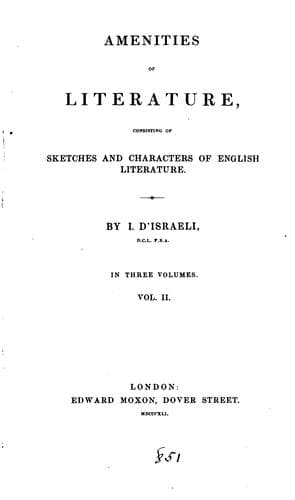
Amenities of Literature: Consisting of Sketches and Characters of English LiteratureDisraeli, Isaac
History
Amenities of Literature: Consisting of Sketches and Characters of English Literature
Disraeli, Isaac
Authors, English -- Biography; English literature -- History and criticism; Great Britain -- Intellectual life
Even great authors glanced with a suspicious eye on these vicissitudes
of language, not without a conviction that they themselves were
personally interested in these uncertain novelties. It would seem as if
Milton, from the new invasion of Gallic words and Gallic airiness which
broke in at the Restoration, had formed some uneasy anticipations that
his own learned diction and sublime form of poetry might suffer by the
transition, and that Milton himself might become as obsolete as some of
his great predecessors appeared to his age. The nephew of Milton, in the
preface to his "Theatrum Poetarum," where the critical touch of the
great master so frequently betrays itself, pleads for our ancient poets,
who are not the less poetical because their style is antiquated. Writing
in the reign of Charles II., in 1675, he says: "From Queen Elizabeth's
reign, the language hath not been so unpolished as to render the poetry
of that time ungrateful to such as at this day will take the pains to
examine it well. If no poetry should please but what is calculated to
every refinement of a language, of how ill consequence this would be for
the future let him consider, and make it his own case, who, being now in
fair repute, shall, two or three ages hence, when the language comes to
be double-refined, understand that his works are come obsolete and
thrown aside. I cannot--" he, perhaps Milton, continues--"I cannot but
look upon it as a very pleasant humour that we should be so compliant
with the French custom as to follow set fashions, not only in garments,
but in music and poetry. For clothes, I leave them to the discretion of
the modish; breeches and doublet will not fall under a metaphysical
consideration. But in arts and sciences, as well as in moral notions, I
shall not scruple to maintain, that what was '_verum et bonum_' once,
continues to be so always. Now whether the trunk-hose fancy of Queen
Elizabeth's days, or the pantaloon genius of ours be best, I shall not
be hasty to determine."
Public-domain text, read in full here on John Shaqi.
Reviews
Reviews
No reviews yet
Be the first to share your thoughts on this work.
Elsewhere in the archive
Join the Discussion
Join the discussion
Sign in to leave a comment or review.
Sign InorCreate an account